At the end of an eventful day, to say the least, I offer a brief anecdote, just to quell the worst of our impulses to indulge in self-righteous indignation. Just over a year after I returned to Toronto after a forty year absence, John Barber, one of the journalists who spoke for Toronto's downtown urbanists, wrote a column gushing with praise for the lawless thuggery of Richard Daley's destruction of Meigs Field. The former mayor of Chicago destroyed that city's waterfront airport in what Barber described as a "midnight raid", a romantic description leaving out the multiple laws this "raid" broke, or that it endangered everyone in the air over the American midwest that night. If "Ford Nation" has produced a leader determined to get his own way, law be damned, well, they have had some good teachers over the years, and those teachers have sometimes included ourselves and our friends.
Humility alone, though, won't save us. Yes, we, collectively, have contributed our share to the sorry record leading to Doug Ford's determination to cut down every court in the province, if he must, to get at Toronto's City Council. We still have to deal with the situation.
Showing posts with label writing. Show all posts
Showing posts with label writing. Show all posts
Monday, September 10, 2018


Wednesday, December 21, 2016
The value of a tell
 I have seen a number of comments about the movement calling themselves the "alt-right"; these comments argue we should not accept these peoples' name for their movement, but rather call them fascists, racists, national socialists, misogynists, and plain haters. An Internet activist has written a Google Chrome plug-in that renames "alt-right" to White Supremacy or neo-Nazi. The Associated Press has also updated their style guide to require quotes and a full definition whenever writers use the term "alt-right".
 I sympathize with the impulse, but if we reject the name "alt right" we stand to lose potentially useful information. The name a person or a group gives themselves is always a "tell"; it gives away more about the people who take the name than they intend.
Saturday, December 17, 2016
What's in a name?
Atlas Obscura had an article on the Canadian raising, a peculiarity in the way Canadians pronounce certain vowel sounds, most notably the word "about". The article seeks to explain why we pronounce this word the way we do, and why Americans don't hear the way we actually say this particular word. The article says:
Reading this article put me in mind of one of my early memories: at the age of five or six, my great aunt taught me to say my last name.
Canadians also have a diphthong there, but a much weirder one than ours. Instead of starting with “agh,” they start with a vowel that’s mapped in a mid-range place, but one that is, bizarrely, not represented in American linguistics, period. This is an exclusively Canadian sound, one that the vast majority of Americans not only don’t use where Canadians use it, they don’t use it at all. It’s completely foreign.As a linguistic analysis, this works: it explains more clearly than any other analysis I have read not only how we actually pronounce "about" but why the Americans have trouble hearing the sounds we actually use. The word choices in the article reveal some interesting assumptions on the author's part: the word "weirder" and "bizarrely", in this context, appear as synonyms for "foreign".
Reading this article put me in mind of one of my early memories: at the age of five or six, my great aunt taught me to say my last name.
Friday, December 02, 2016
Reasons to Worry, Reasons Not To
 |
| By Gage Skidmore via Wikimedia Commons |
I wish I knew these articles grossly overestimated Mr. Trump's native abilities.
 |
| Homeland Security photo |
At best, a man who has paraded his ignorance and prejudices will soon have the ability to give orders to the most powerful and destructive military on the planet. He will also control the world's most sophisticated surveillance apparatus. This frightens me. It frightens a great many people. It should.
Saturday, April 06, 2013
Michael Kelly and Iraq: Guided by the beauty of our weapons
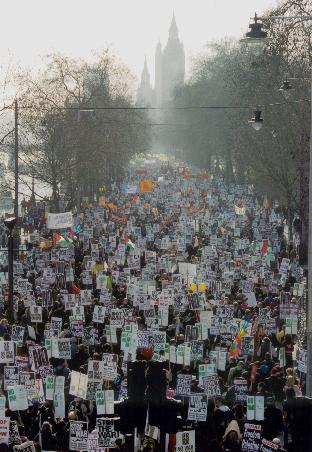 |
| London anti-war march by Simon Rutherford |
I originally intended to say nothing about Mr. Kelly, except that his decision to go into harm's way to document an effort he believed in showed an integrity that many of the war's advocates lacked. But a recent post by Ta-Nehisi Coates, highlighting Michael Kelly's writings in support of the war, included a good example of the problems in the thinking that led to the Iraq war. Those same problems had a lot to do with the ultimate American failure in Iraq.
Tom Scocca quotes Kelly's defence of the moral case for war in Iraq:
Tyranny truly is a horror: an immense, endlessly bloody, endlessly painful, endlessly varied, endless crime against not humanity in the abstract but a lot of humans in the flesh. It is, as Orwell wrote, a jackboot forever stomping on a human face.Ta-Nehisi Coates quotes the thoughts of Michael Kelly as an embedded reporter waiting for the invasion:
It is remarkable enough that the United States is setting out to undertake the invasion of a nation, the destruction of a regime and the liberation of a people. But to do this with only one real military ally, with much of the world against it, with a war plan that is still, by necessity, in flux days before the advent, with an invasion force that contains only one fully deployed heavy armored division -- and to have, under these circumstances, the division's commander sleeping pretty good at night: Well, that is extraordinary.As someone who does not believe, implicitly, in the absolute goodness of American military power, I see a boot in those paragraphs. As events played out over the following half decade, we saw that boot crash down on many faces: at Abu Ghraib, in uncounted house raids, in the incompetence and corruption that left Iraq an impoverished ruin, the money for reconstruction disappeared, opportunities squandered and lives wasted. It started with the belief, the ecstatic belief, that American military power could make the world anew, starting with Iraq.
A victory on these terms will change the power dynamics of the world. And there will be a victory on these terms.
Reading Orwell, it does not do to take the "boot" quote out of context. Orwell gives his interrogator the lines he does because he needs to expose the lies behind the worship of power. The real thing, the virus in the wild, almost always wears a mask. If we expect a interrogator like the one in 1984, we shall mistake the real face of power and cruelty, which even in its sadism feigns benevolence. A person with the character and insight to see the boot on their own foot almost always tries to take it off.
American power, American weaponry seduced many Americans outraged and terrified by the vulnerability 9/11 had shown them. Dazzled by their weapons and new forms of military organization, they never saw the boot on the face of Iraqis, never saw that the military and political power they supported wore that boot.
Saturday, May 05, 2012
Emotions (II) Illusion vs. Wisdom
 Western post-enlightenment culture provides us with poor guidance for understanding the place of emotion in our lives. We steer between two extremes: the Cartesian exaltation of linear thought, which rejects emotion as a distraction, and the dregs of nineteenth century romanticism, which leads us to see emotion as a source of free wisdom. I believe both these attitudes badly miss the truth: our emotions do indeed provide us with an important path to wisdom, but it doesn't come free. It takes more than just listening.
The best theory I have ever read about the origins and uses of what we call emotion comes from Rupert Ross's book Dancing with a Ghost, which talks about the complex and subtle pattern matching our minds perform. Ross writes of his early work as a fishing guide, when he learned to match the subtle sign of weather, season and temperature with his knowledge from past experiences. In his description of the process, Ross notes the step by step methods we more often associate with "reasoning", and the Cartesian methods for discovering information simply do not have the speed necessary to deal with life in the wilderness. But that speed comes at a cost: where we can step back through a line of reasoning to discover where we made an error, the kind of non-linear process Ross speaks of does not permit that. We can choose to trust what we feel, or not. For the First Nations people who live on the land, the environment provides continual instruction. Those of us who live in a constructed media environment do not experience the immediate truth of the physical world. We receive too many messages manipulated, or invented outright, mainly for the purpose of manipulating us. In other words, we take in a lot of garbage. And as the old computer saying goes, when garbage goes in, garbage comes out.
If the old romantic idea of simply trusting our feelings ever made sense, our current media environment, stuffed with lying political rhetoric, deceitful advertising, and subtle manipulations of every kind makes that impossible today. At the very least, if we hope to gain wisdom from our emotional reactions, we need to check them both against what we know about the world, and against other things we remember feeling.
Wednesday, April 25, 2012
Emotion (I) Attunement and Entitlement
Please note: this post discusses the work of Hugo Schwyzer
One of Hugo Schwyzer's recent posts defended womens' use of the word "creep" as a necessary and appropriate assertion of boundaries. He writes:
Hugo does not appear to have given up his sense that his ability at emotional attunement has in some sense entitled him to the attention he could persuade women to grant him. In an interview with Clarisse Thorne, at Role Reboot, he said this:
I don't envy Hugo's life. But I find his use of the word entitlement in the above quote interesting. Despite his acknowledgement of the destructive nature of so many of his actions toward women, he never admits that if indeed he has an unusual ability at emotional attunement, he severely abused his gift.
In other words, it seems that he believes that the "instinct" that leads women to label men "creeps" provides a critical defence for women, he has, or thinks he has, a private back door around that defence. Despite his acknowledged history of dangerous behaviour, he has expressed no sense that he ought not to have that back door, or at least he should never have used it.
One of Hugo Schwyzer's recent posts defended womens' use of the word "creep" as a necessary and appropriate assertion of boundaries. He writes:
At the heart of the "anti-creep shaming campaign" is a concerted effort to discourage women from relying on their instincts to protect themselves from harm... [the word creep] forces men to reflect carefully about how they make women feel.Predictably, Hugo's detractors reacted to his comments with outrage, but they did not appear to address the deepest irony in Hugo's comments directly. Because, in fact, the instincts behind the word creep lie at the very center of what Hugo describes as his power: his claim to have a gift for emotional attunement. As he puts it in one of his posts on the subject:
I was a “student of my mother’s emotions.”... I did become very, very good at taking her emotional temperature.In a followup, he wrote:
At six I had become acutely aware of my mother’s feelings; twenty years later, I was a chronic seducer because I imagined I was “so good” at “reading” women well.By his own account, during his life as a "chronic seducer" and drug abuser, he behaved in very dangerous ways: dangerous to himself, and even more to women around him. When he his addiction led him to complete despair, he attempted suicide, and by his own account tried to make it murder-suicide, deciding that a woman who had come to him for help had reached such a hopeless state that they both needed to die together. If I had to make a case against the proposition that the "instinct" that leads women to label men "creeps" keeps them safe, I would produce Hugo's own story as the first piece of evidence.
Hugo does not appear to have given up his sense that his ability at emotional attunement has in some sense entitled him to the attention he could persuade women to grant him. In an interview with Clarisse Thorne, at Role Reboot, he said this:
I do understand why some men who have found it difficult to meet women are angered by what I’ve shared. When I write about my destructive past, even in passing, some guys hear me saying something like “You shouldn’t even get a chance to try the naughty things I spent so many years doing before I came to my right mind.” That’s true for anyone who shares a story of redemption.
In the end, though, no one is “owed” sex. Other people do not have a moral obligation to get naked with you. And what bugs me most is that the envy, if that’s what it is, is so often tinged with a sense of entitlement.
I don't envy Hugo's life. But I find his use of the word entitlement in the above quote interesting. Despite his acknowledgement of the destructive nature of so many of his actions toward women, he never admits that if indeed he has an unusual ability at emotional attunement, he severely abused his gift.
In other words, it seems that he believes that the "instinct" that leads women to label men "creeps" provides a critical defence for women, he has, or thinks he has, a private back door around that defence. Despite his acknowledged history of dangerous behaviour, he has expressed no sense that he ought not to have that back door, or at least he should never have used it.
Wednesday, March 24, 2010
When words fall over each other
The American Scene web log allows comments. Their blogging software has a feature which only accepts comments after the writers have reviewed what they have written.
For those, like myself, who often find errors in our comments only after we have posted them, this feature provides a distinct advantage. I find that as I type, my thinking often outruns the signals going to my fingers, so I often find a word with the last letter of the word I had intended to type before it attached. Also, when I go back and change a sentence, I often leave a word that no longer belongs. Previewing my work beforehand sometimes saves me from looking foolish.
For those, like myself, who often find errors in our comments only after we have posted them, this feature provides a distinct advantage. I find that as I type, my thinking often outruns the signals going to my fingers, so I often find a word with the last letter of the word I had intended to type before it attached. Also, when I go back and change a sentence, I often leave a word that no longer belongs. Previewing my work beforehand sometimes saves me from looking foolish.
Saturday, February 07, 2009
Liam Neeson takes us through a very bad script
Sometimes I suspect other actors envy Dustin Hoffman most for getting a major acting award for reading the phone book in "Rain Man". While a great script produces a better product, a mediocre or downright bad script leaves the audience, and the critics, in no doubt about where the entertainment value of a film comes from.
Whatever I think of his decision to bring the script of Taken to life, he has certainly turned in a profitable film that appeals to a large audience and a reasonable number of critics; having seen it, I would say that he had no help at all from the script. At some moments in the film, I found myself literally carried along; the intensity of the performance kept me from noticing the absurdity of the situation. For example, early in the film, Neeson's character finds the identity of a member of the gang, locates him, and then proceeds to try to interrogate him in the worst possible place. This pattern in the script, of making the character relatively clever, subtle and methodical when the action requires it, and utterly foolish and impulsive at other times, persists through most of the film. That may work for setting up certain kinds of suspense, but it does not help us believe in the characters.
The dialogue doesn't do much to entertain the audience, either. The script serves up lines used a hundred times before, sometimes so out of context it hurts to watch. In the lead-up to the penultimate scene, I had to wonder if they really, really intended to do what they did, and then even the legendary acting ability of Liam Neeson could not carry me any further. I found myself thinking that Lloyd Simandl does this kind of thing better. But even as I alternately cringed or laughed as the script went from preposterous to absurd and the remaining minutes of the film ran out, Neeson's performance had a separate life. The script writer may have had complete contempt for the audience, but the actor never stopped giving us everything.
Europe actually has a problem with sex trafficking, one that has absolutely nothing to do with American kids getting kidnapped from upscale Paris apartments (any Albanian gang that decided to try that would find themselves in prison, probably with serious injuries, before you could say Natalee Holloway). A writer with more talent and conscience could have given us a much better film on the subject: made Maggie Grace's character an aspiring journalist, followed the macabre dance of the real slavers, their enablers and victims, the reporter trying to expose them, and the reporter's father in the shadows, ready to protect her and spring his own trap on the villains. Perhaps someone will make that film, or one like it, that tells something like the real story of human trafficking in twenty-first century Europe. And if that film gets made and opens people's eyes, some of the credit may have to go to the people who proved that a bad film about human trafficking could make money, and to the brooding actor who made that film work.
Tuesday, December 04, 2007
A word to beware of...

Human, as an adjective, applies to all people and to everything we do, from writing poetry, composing music, and curing disease to cutting up the neighbour's children with a machete. However, plenty of writers use "human" in a poorly defined but strongly positive sense, referring to some act or attitude as "more human" to show approval, and "less human" to show the opposite. The very breadth of the word "human" makes it vague, which means an author can use it to express an attitude without explaining it.
Piling on vague adjectives only serves to multiply the vagueness, making a statement that only looks strong, because it deals with something that the writer never actually defines. You do not have to look too far, for example, to find someone using the phrase "authentically human". It usually seems to apply to something the author favours, although in fact, for example, Auschwitz authentically happened, and sad to say, human beings authentically did it, which makes Auschwitz as authentic an example of human behaviour as any of the other things we know human beings do.
I do not believe writers often use vague phrases like "authentically human" to express our own feelings; we usually describe our own feelings more clearly. I think we use vague phrases because we want other people to adopt our attitudes and beliefs, and not knowing the people who will read what we write, we cannot clearly tell them why they should. In other words, when we write vaguely, we do so because we want to have power over our readers, rather than share with them.
Subscribe to:
Comments (Atom)