Showing posts with label war. Show all posts

Sunday, October 19, 2025

Future Discount: Israel and Palestine

We have almost all had some experience with the concept of future discount: the snooze button now versus the good things studying harder for the test might make possible in the future. The exhilaration and social cachet of your own car now against the future advantages of having saved up and taken the bus. For too many people, future discounting means weighing the escape the pill, the pipe, or the needle offers now, versus the chances for the uncertain possibilities of a better future.

Few forms of future discounting have the seductive nature, or pose the dangers, of apocalyptic religious belief. A coming apocalypse justifies gratifying the present at the expense of the future because God will call an end to the world. The righteous, whether they provide for the future or not, will receive their eternal reward. In that system, imprudence does not look like self indulgence, or as a pursuit of pleasure with consequences others may have to pay for. Rather, it appears as as an affirmation of faith.

Monday, August 26, 2024

Project 2025 and "schedule 'F'"

A picture of a gold plated bronze sculpture of the signature "Make America Great Again" hat of the Trump campaigns.
Republicans complain the Democrats have set out to terrify the public with references to Project 2025. They point out the project did not come from the Republican Party, but from the Heritage Foundation, a right wing policy development and influence organization. The Heritage Foundation operates at arm's length from the Republican Party and the Trump campaign, but all three entities belong to the larger American Conservative movement, and the personnel in the Heritage foundation, including the staff responsible for Project 2025, overlaps with the personnel of the Trump Administration of 2017-2021 to a significant degree.

The project itself consists of a public policy framework, containing both broad ideological outlines and specific implementation details. Its authors have divided it into several phases: the initial policy document, titled Mandate for Leadership, which they have released publicly, then a series of training videos, which have been leaked to ProPublica, and a number of other as yet unpublished documents.

Tuesday, August 20, 2024

The mask is right off

Picture of the US Army Medal of Honor
This time he said it before a microphone and TV cameras. Donald Trump claimed that from his perspective the Presidential Medal of Freedom, which he has awarded to, among others, donors, professional athletes, politicians, and radio commentator Rush Limbaugh "is better" than the Medal of Honor. He claimed the medal of freedom is "better" precisely because recipients do not have to sacrifice their health or their lives.

Donald Trump has made it clear from the outset that he despises service and sacrifice. He has repeatedly, and very publicly, rejected the notion that those who sacrifice themselves for the good of others have a claim on their fellow citizens. He dismissed the five and a half years his political rival John McCain spent in brutal captivity for his country with a sneer: "I like people who weren't captured, OK?". When the family of Humayun Khan, who had given his life in Operation Iraqi Freedom, appealed to Donald Trump to abandon his Islamophobic policies in the name of the United States Constitution, and of their son who had given his life for that constitution, Donald Trump dismissed them by doubling down on his Islamophobic positions.

Saturday, January 13, 2024

Friends like these

Daniel chapter 7, verses 2-10. Daniel's vision of the four beasts from the sea and the Ancient of Days
 Recently, Barbara Kay published an opinion piece praising the International Christian Embassy in Jerusalem, calling the organization a "true friend of Israel". 

Israel does have friends, and quite possibly many supporters of the International Christian Embassy have the best possible intentions for Israel, Israeli citizens, and the wider Jewish community. However, by no means do all so-called "Christian" "Zionists" have the best interests of Israel in mind.

Monday, January 08, 2024

Trauma informed


The image carries a meaning in a way very few others do.A squat tower with an ill proportioned and ugly railway gate, it serves as an instantly recognizable shorthand and an indelible stain on the history of our civilization. In the history of past five hundred years, an age of endless empire, of ever more destructive wars and increasingly empowered hatreds, this one image in all its meanings occupies a unique place. This gate opens onto a killing machine capable of  efficiently carrying out a million murders, a large proportion of more than six million murders in the four years between the Nazi invasion of the Soviet Union and the fall of Berlin. Together, the murder and enslavement beyond this gate created the index trauma of our time. We measure other crimes, other catastrophes, and other horrors against this one.


Thursday, August 24, 2017

What the People Who Sent Murderers to Barcelona Want

Sagrada Familia 02
Sagrada Família
A terror cell affiliated with the deash has murdered fifteen people and injured one hundred and thirty more.

Pray for the dead and for the recovery of the injured. And don't give the hard men of the daesh, who sent the killers, what they want.

Thursday, May 25, 2017

Logophobia

Cast iron cover with the name "Manchester"Rod Dreher, in common with most of the rest of the world, struggles to make sense of the senseless: the bomb exploded in a crowd of women and girls at an Ariana Grande concert and the resulting slaughter of innocent people.

In the process, he makes a very interesting set of comments, and displays what I call "logophobia", meaning fear of and revulsion toward a specific word, rather than a repudiation of the concept behind it.

Thursday, February 09, 2017

The white battalion

Donald Trump on the campaign trail by Gage Skidmore via Wikimedia Commons
by Gage Skidmore , via Wikimedia Commons

A friend and colleague of mine, an officer in the Canadian Infantry, taught me "Old King Cole" ("beer beer beer said the privates, merry men are we"), and he taught me about the White Battalion. The White Battalion is a tradition in the Canadian Forces, or at least in some regiments. It is a term for the regimental dead. As my friend explained to me, regiments disband, their colours hung on the walls of churches for time and nature to return them to the Earth, but white battalion never disbands; its members are transferred to an active regiment. Soldiers remember, honour, and grieve.


The act of remembering war dead has many expressions in many places, but it works out to the same basic contract: a society will ask its young men, and in some cases its young women, to put themselves in harm's way for the sake of the nation. In return, the nation will carry the names of everyone who gives their life in its service down through history in honour. It is a covenant painted on the walls of thousands of churches. It is carved in the stone of war memorials in villages and cities across the world. It forms the basis for a signature piece of American political rhetoric: Lincoln's Gettyburg Address. It is a part of the hearts of millions of families.

Monday, February 06, 2017

What's wrong with David Frum's excellent article

Rob Ford with council colleagues - subway announcement 2012 by HiMY SYeD via Wikimedia Commons
by HiMY SYeD via Wikimedia Commons
David Frum recently wrote an excellent article in the Atlantic Monthly on the possible development of an authoritarian populist state under Donald Trump. Read it if you haven't already.

David Frum comes from Toronto, but he left many years ago for the United States. He did not live through Toronto's experience with insurgent populist conservatism. That may or may not have led to what I regard as the most interesting omission in a very good article.


Tuesday, December 27, 2016

The sales force for war is out

...and experience suggests we can expect another round of trashing for Neville Chamberlain. That guy. Every hawk with a war to sell, or a conflict to stoke, or a peace initiative to shut down, drags out the same carpet beater and flogs the very dead horse of Neville Chamberlain's unavailing concessions at Munich. Even ones who can't say exactly what Chamberlain did at Munich.


Neville Chamberlain died in November of 1940: Winston Churchill gave the eulogy at his funeral, and even with bombs raining on London, could say of Chamberlain's policy:
But it is also a help to our country and to our whole Empire... [that] we were guiltless of the bloodshed, terror and misery which have engulfed so many lands and peoples, and yet seek new victims still. Herr Hitler protests with frantic words and gestures that he has only desired peace. What do these ravings and outpourings count before the silence of Neville Chamberlain's tomb? Long, hard, and hazardous years lie before us, but at least we entered upon them united and with clean hearts.
Many people in the present day who know far less than Churchill take a far less charitable view. Why does this matter? Do I really intend to waste time defending an old, white man whose maintenance of the imperial system undoubtedly fed the great conflicts of the 20th century?

Saturday, November 14, 2015

Pray...

for the people of France mourning loved ones. And the people of Lebanon. And Syria, Iraq and Russia. Pray for everywhere terrorism leaves its ugly imprint.

Wednesday, December 10, 2014

I remember...

as a child watching the first runs of Mel Brooks's Get Smart with my parents. In one of the episodes a character mentioned torture, and my mother said the American forces would never use torture.

My mother did not indulge in illusions about Americans. She never saw the United States with awe or reverence or as the exceptional and unique nation many Americans profess to see. She saw a nation among all others, home of Janas Salk and Bull Connor, Martin Luther King and George Wallace, John F. Kennedy and H. L. Hunt. She saw a country with manifold, even brutal flaws, a country capable of great good and great evil, a country where, in that moment, the good outweighed the evil. Above all, she saw a country which stood for something, something that included a code of conduct. And that code of conduct simply excluded torture.

I refuse to believe that country no longer exists. I believe many, many Americans still hold to and live the basic American propositions about the fundamental dignity of human beings, and would never engage in. or condone, torture. The American Empire may have grown over the American Republic, but it has not devoured the American Republic. Yet when I read long discussions in comments on the recently released US Senate report of CIA torture, discussions focussed entirely on the question of utility, of whether torture works, I cannot shake the conclusion that my mother would find many contemporary Americans deeply dsappointing.

Saturday, April 06, 2013

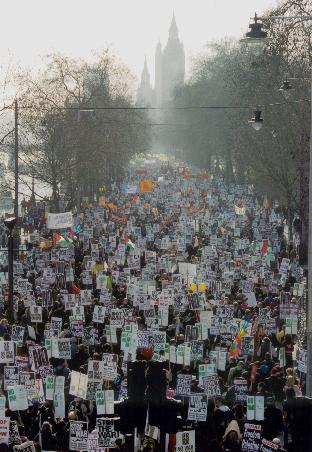
Michael Kelly and Iraq: Guided by the beauty of our weapons

London anti-war march by Simon Rutherford
Over the past month, we have seen various ten year assessments of the decision by then President George W. Bush to go to war in Iraq. Most recently, writers at the Atlantic have posted retrospectives of the first journalist to die in that war: Michael, and journalist who had, among other things, edited the Atlantic Magazine. Mr. Kelly, an avid supporter of the war, had gone to cover it as an "embedded" journalist with the American army.

I originally intended to say nothing about Mr. Kelly, except that his decision to go into harm's way to document an effort he believed in showed an integrity that many of the war's advocates lacked. But a recent post by Ta-Nehisi Coates, highlighting Michael Kelly's writings in support of the war, included a good example of the problems in the thinking that led to the Iraq war. Those same problems had a lot to do with the ultimate American failure in Iraq.

 Tom Scocca quotes Kelly's defence of the  moral case for war in Iraq:
Tyranny truly is a horror: an immense, endlessly bloody, endlessly painful, endlessly varied, endless crime against not humanity in the abstract but a lot of humans in the flesh. It is, as Orwell wrote, a jackboot forever stomping on a human face.
 Ta-Nehisi Coates quotes the thoughts of Michael Kelly as an embedded reporter waiting for the invasion:
It is remarkable enough that the United States is setting out to undertake the invasion of a nation, the destruction of a regime and the liberation of a people. But to do this with only one real military ally, with much of the world against it, with a war plan that is still, by necessity, in flux days before the advent, with an invasion force that contains only one fully deployed heavy armored division -- and to have, under these circumstances, the division's commander sleeping pretty good at night: Well, that is extraordinary.

A victory on these terms will change the power dynamics of the world. And there will be a victory on these terms.
As someone who does not believe, implicitly, in the absolute goodness of American military power, I see a boot in those paragraphs. As events played out over the following half decade, we saw that boot crash down on many faces: at Abu Ghraib, in uncounted house raids, in the incompetence and corruption that left Iraq an impoverished ruin, the money for reconstruction disappeared, opportunities squandered and lives wasted. It started with the belief, the ecstatic belief, that American military power could make the world anew, starting with Iraq.

Reading Orwell, it does not do to take the "boot" quote out of context. Orwell gives his interrogator the lines he does because he needs to expose the lies behind the worship of power. The real thing, the virus in the wild, almost always wears a mask. If we expect a interrogator like the one in 1984, we shall mistake the real face of power and cruelty, which even in its sadism feigns benevolence. A person with the character and insight to see the boot on their own foot almost always tries to take it off.

American power, American weaponry seduced many Americans outraged and terrified by the vulnerability 9/11 had shown them. Dazzled by their weapons and new forms of military organization, they never saw the boot on the face of Iraqis, never saw that the military and political power they supported wore that boot.

Tuesday, June 08, 2010

...a long time coming

Jeffery Goldberg ascribes the recent events in regard to Gaza aid flotilla to military and short-term political incompetence. I think that does the Israeli politicians and generals a disservice. As long as Israeli forces maintain the Gaza blockade, by all accounts a popular policy in Israel and a very unpopular one elsewhere, people willing to risk death can make Israel look bad. The Gaza relief ships simply have to keep steaming toward port to compel the Israeli military to either abandon the blockade, or to use force and risk subsequent casualties.

Rather than blaming the Israeli Defence Force, it helps more to ask how the Israeli government got their tails in this particular crack. It seems to me that Israel blockaded Gaza in despair, because they had run out of options. Having beaten the corrupt Fatah party in the election of 2006, Hamas had a earned, by the normal rules that govern these matters, a right to govern. But governing the Palestinians meant working with the Israeli government, and the Israelis could find no way to work with people dedicated to their destruction. Here, I believe, two quite understandable impulses in Jewish life collided with disastrous results.

The first impulse, which for convenience I will refer to as the ADL impulse in honour of the Anti-defamation League, holds that the Jewish community cannot ignore or condone hostility. The second impulse, which I call the IDF impulse in honour of Israel's defence forces, says that the Jewish community can never afford to rely on goodwill alone, because enemies can overpower even the most sincere of friends. Both impulses make sense, given Jewish history, but they lead to fatally contradictory policies. If you have power, you can dictate to your enemies what they can and cannot do without having you punish them for it, but you can't try to force them to like you. A policy based on the IDF impulse would have ignored Hamas rhetoric, but punished any government led by Hamas for hostile actions against Israel. A policy based on the ADL impulse would have deplored the hostility to Israel shown by Hamas, but not used force in response to it. In fact, it appears the impulses collided, and Israel refused to recognize the results of the election both because of the past terrorism by Hamas and also because of the ongoing hostility of Hamas to Israel.

If Fatah had taken control of Gaza by force, then Israel could have released the blockade. But since Hamas won the election and the subsequent power struggle in Gaza, I can see few good options for the Israeli government short of a more general settlement with the Palestinians. In the meantime, blaming the situation on Israeli commandos, or even on the planning staff of the Israeli Defense force, strikes me as a less than useful simplification.

Saturday, February 27, 2010

Who could have guessed...

that the moral hazards of an international legal regime that forbids war would include fecklessness on matters of war and military policy?

A couple of weeks ago, our junior foreign minister announced that “an attack on Israel would be considered an attack on Canada.” Years ago, before the UN charter forbade war, we used to call a declaration like that a security guarantee. Governments thought before they made such guarantees, because they might have to back them up. When Franklin Roosevelt came to Queen's University and announced in 1938 that the United States would not "stand idly by" if a foreign power threatened Canada, he understood, and the Canadian government understood, that he pledged American lives and treasure. Everyone in the American and Canadian governments understood the seriousness of his statements.

Fast forward to the present. The UN charter renounces the use of force, Israel needs no help with conventional defence, and Canada has little meaningful help to offer with the dilemmas which really cloud Israel's future. Why should a junior minister not throw a little "red meat" to the "Christian Zionists" and other supporters of current Israeli policy, whose support his government has zealously courted? In a dangerous world, governments should retain a sense of responsibility about the statements they make. Perhaps this one statement will not lead directly to any bad results, but it does not do to get into the habit of making statements about serious matters without evidence of serious thought.

Wednesday, November 11, 2009

November 11

To begin at the beginning: Basil Launcelot Cumpston, my great uncle, fatally wounded near Bullecourt, 1917; John Cox, my cousin, died in when his Dakota went down in Myanmar, 1945. George Weber and Tom Fox, CPT colleagues, died in Iraq, 2003 and 2006. Andrew Olmsted, a US Army major and a web log author I admired, died Iraq 2008. Relatives, colleagues and friends who have sacrificed their lives for a better world link all of us to war, and we have come around, once again, to the day of the year which we set aside to remember them.

The hardest part of remembering is reconciling our debt to the men and women who died with our determination to avoid sending our own children to die in the future. I and millions of others can say of our relatives who gave their lives in the Allied Cause during the Second World War, that they died in a noble cause. But then we come face to face with an uncomfortable truth: good men and women only die in noble causes because bad men find it easy to trick or force people to kill, and die, for bad causes. If so many men had not followed Adolf Hitler and Hideki Tōjō, millions of men and women would not have had to go off to war. And facing that truth, too, we confront another: advancing the noble cause Allied soldiers, sailors and aviators fought and died for required years of struggle that went on years after the war and well beyond the borders of Germany or Japan. The militarism of Imperial Japan or the genocidal fury of National Socialism were only extreme cases of racist ideologies that stained all Western societies. Denazification did not only happen in Berlin and Nuremberg; Martin Luther King's march on Selma, decolonization in Africa and Asia, First Nations struggles in Canada, all formed an essential part of the process which, we can hope, will prevent genocidal fascism from ever rising again.

The clash of arms only begins the process of building a better world. If we carry on most of the work without violence, we must still commit to it, give our all, and accept the reality that humanity will never move forward without struggle and sacrifice. And so today we will remember those who struggled and laid down their lives, whether with guns or with empty hands. And we too will pick up the task they laid down, and do our best to carry forward the work of building a better world.

Monday, October 12, 2009

...how much can you blame them?

The Obama administration would very much like to resettle the Guantanamo detainees their predecessors picked up in error; the innocent people (mostly men) caught in the backwash of the badly misnamed war on terror. In the frantic early days after 9/11, when so many of us thought al Qaeda had the resources to mount a whole campaign of terror against the United States, a terrorist was a terrorist if his uncle, or his tribal leader, or the bounty hunter who showed up with him in Peshawar or Kandahar said so. We all know the result that the Obama Administration wants us to help make up for.

And we ought to. We took part in the war on terror. To the eternal credit of our government and especially of M. Chretian, we wanted to see it waged sensibly, but we had, and have, troops and special forces in Afghanistan and ships in the Indian Ocean. Some of the people taken into custody by our forces almost certainly ended up in Guantanamo or some other, even more secret prisons. We didn't make the mess, but we helped. So why not help do justice now?

Well, for exhibit 'A', meet Janet Napolitano, the secretary of Homeland Security for the United States, who eight years after 9/11 thinks Mohammed Atta and his fellow evildoers entered the United States over the Canadian border, and who has invoked that misconception in defending the expensive and highly disruptive program to require passports from all travelers at the US/Canada border. For exhibit 'B', consider Maher Arar, a Canadian citizen shipped to Syria by the Americans (with the apparent connivance of Canadian officials). The Americans have banned Mr. Arar from their country and their airspace, and still refuse to tell the Canadian government why. If Canadians have a real problem with the persistence of myths in the American public discussion, and if Canadians find the American government less than transparent in the war on terror, we have reason to.

And thanks to another ideology many leading Americans hold dear, the idea of the global economy, any Canadian government that fails of the border file has a lot to lose. We embraced continental economic integration with the Free Trade Agreement, and later extended it with NAFTA. Whether that made sense or not, we now have a fully integrated North American market. Should some American demagogue take advantage of the presence of the remarkably persistent myths of 9/11 hijackers coming from Canada, compounded by any so-called "gitmo terrorists" we accept to severely restrict the border, both countries will get shot in the foot; but the US, a country ten times as big, will take a lot longer to feel the pain.

So much as I like and admire President Obama, and as much as I consider Steven Harper at best a placeholder in the Prime Minister's office, I still have to admit that our government has real reasons not to want to take any Guantanamo detainees.

Wednesday, November 12, 2008

Rememberance and faith

Yesterday, I stood with a crowd of people in the center of Toronto, at the cenotaph by the Old City Hall. We stood in silence awaiting the hour: the eleventh hour of the eleventh day of the eleventh month, when ninety years ago, the guns fell silent. As the notes from the bell in the old city hall clock faded, a bugle played the haunting notes of last post, and a flight of four Harvard trainers passed overhead, just over the tall buildings of downtown Toronto. As the passed us, one pitched up and made a climbing turn westward, in that most moving of all aviation displays, the missing aviator formation.

I thought of memory, and how the custom of sounding horns in honour of the fallen probably dates back to pre-Christian times, when my forbears honoured Arawn, the hunter of the dead, consort of the Great Mother. I thought of the wheel of time. I thought, too, of this. Both my grandfathers took part in the Great War. They returned after the armstice, and eleven years after the eleventh day of the eleventh month came the birth of my parents. And politicians let go of the promise that my grandfathers had endured the mud and the horror and the death to end all wars, and Hitler plunged the world into another war even worse than the Great War. And eleven years after that war, my parents welcomed me into the world.

And I thought of this too: that if we continue to permit war, accept war, then we do not merely break faith yet again with those men who, ninety years ago, fought to end all wars. We break faith even more terribly with our children, because unless we make an end to war, they have no future. For our society has developed the means to destroy itself, and we know that, soon or late, those means will fall into the hands of someone in the throes of dark pain and hopelessness, or of unthinking belief. They will come, in other words, to someone who will use them. And then we shall have no civilization, and the Earth will no longer support it inhabitants, and if anyone survives, they will count themselves less fortunate than the dead.

Therefore, let us never dare remember the sacrifice without the promise that prompted it. Every day we let by without looking for a way to keep the promise given to those millions of suffering men, those ninety years and more ago, we break faith anew.

Sunday, September 14, 2008

Peeking over the Fence: a Dangerous Assumption

On the subject of Sarah Palin's controversial prayer for wisdom in the context of the Iraq war, Julie Ponzi writes:

No fair-minded person could read that as an assertion that our task abroad is certainly "from God." It is, rather, a prayer that the task will be a task from God, i.e., a prayer that we would do as God approves. It is, as she said, an invocation of Abraham Lincoln’s prayer that we might have the wisdom and the fortitude to do as God would have us do and not any kind of claim to special or privileged knowledge of the will of God.

This analysis makes a great deal of sense, but it interests me that many of the "movement conservatives" who explain what Palin's prayer "really meant" have apparently not thought through the implications. Sarah Palin's prayer implies that as an official of the US government she would act, first and foremost, as a humble servant of the Creator. If so, we can expect that many of the arguments made by secular conservatives about national interest and power politics would have no effect on her. Many of the neo-conservatives who have hailed her as the hope for salvaging the McCain campaign appear to assume that if elected, she will shape her faith to conform to their ideological needs and policy prescriptions; that she will claim, as conservatives before her have done, that American power by definition has the blessing of the Creator.

Anyone who assumes they can manipulate or predict Governor Palin's religious convictions would do well to read the history of people like William Wilberforce, John Newton, and the Great Awakening. They might follow up that with a look at trends within the American evangelical community. A clear understanding of that history will reveal something that properly ought to alarm the neo-conservative movement: the arguments of people such Jim Wallis and Ron Sider may well reach her more effectively than theirs.

Neo-conservatives and their allies the "national greatness" or "Jacksonian" conservatives share this essential error with secularist liberals: the delusion that social and political change can only come through a secular argument that both changes individual minds and harnesses the power of the government. But that overlooks the role of faith in all of the great positive paradigm shifts of past centuries, from abolition to civil rights. Those secular conservatives, and especially the conservative political operators, who think they can control the church and make Christian doctrine conform to their idea of the national interest simply haven't paid attention to either history or to current trends.

Link via Jim Henley.

Saturday, January 05, 2008

A post I did not want to write...

I read a number of web logs, but for thoughtful comments on American life and politics, I look very often at Obsidian Wings, a group weblog designed to span the (American) political spectrum. On of the posters there, Andrew Olmsted, an officer serving in the American army in Iraq, died in Iraq at the beginning of this year.

In a wretched irony, my most recent comment to Obsidian Wings responded to the graphs of casualty figures by pointing out that you can never understand what casualty figures mean unless you know someone who has died, heard the voice now stilled, remember the friend now absent. I will miss the voice of Andrew Olmsted, a straightforward and decent man who always had something worthwhile to say.

Whether you believe making peace requires making war, or whether you believe, as I do, that the time for war has long passed, you cannot address the great issues of the time without taking personal risks. I work with people who have faced the lawlessness of occupied Baghdad and the horrors of civil war in the Congo and Colombia. Neither peacemakers nor soldiers can hope to change the world without the honour, courage and grace in the midst of misery that they (and Andrew Olmsted) showed. My condolences and prayers go out to his family.