Showing posts with label Last post. Show all posts

Tuesday, August 20, 2024

The mask is right off

Picture of the US Army Medal of Honor
This time he said it before a microphone and TV cameras. Donald Trump claimed that from his perspective the Presidential Medal of Freedom, which he has awarded to, among others, donors, professional athletes, politicians, and radio commentator Rush Limbaugh "is better" than the Medal of Honor. He claimed the medal of freedom is "better" precisely because recipients do not have to sacrifice their health or their lives.

Donald Trump has made it clear from the outset that he despises service and sacrifice. He has repeatedly, and very publicly, rejected the notion that those who sacrifice themselves for the good of others have a claim on their fellow citizens. He dismissed the five and a half years his political rival John McCain spent in brutal captivity for his country with a sneer: "I like people who weren't captured, OK?". When the family of Humayun Khan, who had given his life in Operation Iraqi Freedom, appealed to Donald Trump to abandon his Islamophobic policies in the name of the United States Constitution, and of their son who had given his life for that constitution, Donald Trump dismissed them by doubling down on his Islamophobic positions.

Wednesday, November 11, 2015

The 11th day

of the eleventh month, the guns of the war to end all wars fell silent. The millions of the dead in that war included my great uncle Launcelot Cumpston. Eleven years after the end of that war, my father was born. I was born eleven years after the Second World War; a war in which my cousin John Cox died.

We frequently commemorate the war dead with the phrase "lest we forget". In its original context, the phrase did not refer to the need to remember the dead and the sacrifice they made. It appeared in Rudyard Kipling's poem recessional as a refrain: it calls us to remember that power politics and military might will not keep us safe.

God of our fathers, known of old—
Lord of our far-flung battle line—
Beneath whose awful hand we hold
Dominion over palm and pine—
Lord God of Hosts, be with us yet,
Lest we forget—lest we forget!

The tumult and the shouting dies—
The Captains and the Kings depart—
Still stands Thine ancient sacrifice,
An humble and a contrite heart.
Lord God of Hosts, be with us yet,
Lest we forget—lest we forget!

Far-called our navies melt away—
On dune and headland sinks the fire—
Lo, all our pomp of yesterday
Is one with Nineveh and Tyre!
Judge of the Nations, spare us yet,
Lest we forget—lest we forget!

If, drunk with sight of power, we loose
Wild tongues that have not Thee in awe—
Such boastings as the Gentiles use,
Or lesser breeds without the Law—
Lord God of Hosts, be with us yet,
Lest we forget—lest we forget!

For heathen heart that puts her trust
In reeking tube and iron shard—
All valiant dust that builds on dust,
And guarding calls not Thee to guard.
For frantic boast and foolish word,
Thy Mercy on Thy People, Lord!

let us remember all the men and women who served in war and peace, those who stood guard and those who bound up the wounds, those who gave their lives in battle to resist aggression, and those who laid down their lives to witness that there is another way.

Above all, let us honour the memory of those who died without complacency. I believe the near future must include a day on which we can say: here ended war. I believe that if that day does not come, then a day will come, although nothing will ever mark it, when humanity ended. And I honour the sacrifices made by brave men and women in the armed services of our country.

Saturday, April 06, 2013

Michael Kelly and Iraq: Guided by the beauty of our weapons

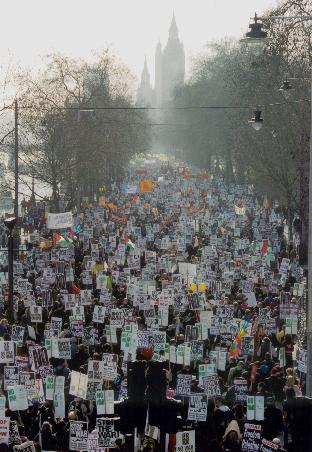
London anti-war march by Simon Rutherford
Over the past month, we have seen various ten year assessments of the decision by then President George W. Bush to go to war in Iraq. Most recently, writers at the Atlantic have posted retrospectives of the first journalist to die in that war: Michael, and journalist who had, among other things, edited the Atlantic Magazine. Mr. Kelly, an avid supporter of the war, had gone to cover it as an "embedded" journalist with the American army.

I originally intended to say nothing about Mr. Kelly, except that his decision to go into harm's way to document an effort he believed in showed an integrity that many of the war's advocates lacked. But a recent post by Ta-Nehisi Coates, highlighting Michael Kelly's writings in support of the war, included a good example of the problems in the thinking that led to the Iraq war. Those same problems had a lot to do with the ultimate American failure in Iraq.

 Tom Scocca quotes Kelly's defence of the  moral case for war in Iraq:
Tyranny truly is a horror: an immense, endlessly bloody, endlessly painful, endlessly varied, endless crime against not humanity in the abstract but a lot of humans in the flesh. It is, as Orwell wrote, a jackboot forever stomping on a human face.
 Ta-Nehisi Coates quotes the thoughts of Michael Kelly as an embedded reporter waiting for the invasion:
It is remarkable enough that the United States is setting out to undertake the invasion of a nation, the destruction of a regime and the liberation of a people. But to do this with only one real military ally, with much of the world against it, with a war plan that is still, by necessity, in flux days before the advent, with an invasion force that contains only one fully deployed heavy armored division -- and to have, under these circumstances, the division's commander sleeping pretty good at night: Well, that is extraordinary.

A victory on these terms will change the power dynamics of the world. And there will be a victory on these terms.
As someone who does not believe, implicitly, in the absolute goodness of American military power, I see a boot in those paragraphs. As events played out over the following half decade, we saw that boot crash down on many faces: at Abu Ghraib, in uncounted house raids, in the incompetence and corruption that left Iraq an impoverished ruin, the money for reconstruction disappeared, opportunities squandered and lives wasted. It started with the belief, the ecstatic belief, that American military power could make the world anew, starting with Iraq.

Reading Orwell, it does not do to take the "boot" quote out of context. Orwell gives his interrogator the lines he does because he needs to expose the lies behind the worship of power. The real thing, the virus in the wild, almost always wears a mask. If we expect a interrogator like the one in 1984, we shall mistake the real face of power and cruelty, which even in its sadism feigns benevolence. A person with the character and insight to see the boot on their own foot almost always tries to take it off.

American power, American weaponry seduced many Americans outraged and terrified by the vulnerability 9/11 had shown them. Dazzled by their weapons and new forms of military organization, they never saw the boot on the face of Iraqis, never saw that the military and political power they supported wore that boot.

Monday, February 11, 2013

In drones we trust

In response to a post by Ta-Nehisi Coates on the drone war, a good few comments blamed American arrogance for the willingness to kill people half a world away by remote control. While anyone who has spent as much time in the United States has encountered American optimism and its darker side, a kind of shallow, pep-rally self congratulation, I think the drone program arises from the darer side of a different American attribute. Americans have the ability to face difficult facts, if not head on then at least in the choices they make. The dark side to that comes out in a pessimism and uncertainty that contrasts with the official sunny American self image. After seventy years of insisting on the superiority of their system over state socialism, the collapse of the Soviet Union still took the American establishment by surprise. Today, the obverse of that pessimism shows not in imagining an invincible enemy, but in an appreciation of the fragility of American democracy.

On September 7, 1941, the Luftwaffe visited upon London an attack very similar to 9/11 in its casualty count and material damage. They kept up that level of violence for 57 straight nights. In proportion to the British population of the time, over the eight and a half months of the "blitz", or sustained bombing of Britain, the Luftwaffe inflicted over a hundred times the 9/11 casualties. British confidence in the war effort stayed high. Winston Churchill stayed popular.

American commentators have made their doubts that American democracy could sustain such an attack pretty clear. A contributor to Jim Henley's web log Unqualified Offerings put it thus: "if the American people react the way that I fear they will, then we will be truly screwed." The use of drones looks more like an improvised response to a deep insecurity. American drone policy looks more like the outcome of a group of people groping for the best way out of a bad situation than calculated evil. Given uncertainty about the robustness of American democracy in the face of a determined terror attack, I would expect American politicians and commentators to accede, in a somewhat queasy fashion, to the Obama administration's drone program; pretty much what they seem to have done.

Americans share this combination of brassy self-congratulation and inner uncertainty with most other nations, or at least with most other nations that aspire to the status of great power. And today, the Americans have considerable reason for uncertainty: the rapid development of technology has changed human conflict. Toward the end of the cold war, policy makers on all sides used irregular forces and armed groups to do what government troops had once done. In this century, politicians and others use robot weapons to do what human fighters used to. We live in a world of melting rules and boundaries written on the water. American leaders, and the American people, and in fact all of us, should feel troubled and uncertain.

Sunday, November 14, 2010

The persistence of (disputes over) memory

I remember the wars of the past and the war we have chosen to fight today  in Afghanistan. I remember the wars that came before that. I remember how one war frequently leads to another, the compromises made for peace in one generation leading to the failure of peace in the next. What aware person with a mind and conscience can forget?

I remember all year long. Every time I participate in the political process, I remember that people have put their lives on the line for my right to do so, and whether or not I believe their sacrifice produced my freedom, I know they thought it would, and I remember and honour their willingness to make it. I remember the men and women who endured the wars, who went to fight and gave up their youth and the soundness of their bodies and the peace of their minds, and I honour the choice they made to do that for all of us, even if I don't agree with the specific cause they fought in.

And at the same time, I face the paradox that confronts everyone who remembers and honours those who fought for their country. As Jimmy Carter rightly said, the necessity of a particular war does not make war any less of an evil. In 1939, Canada and Britain may have had no choice but to fight, and the young men of this country who flocked to the colours then have my full measure of gratitude. But they would not have had to go if Hitler had not persuaded young Germans to flock to the colours of blood and night. Good people only have to fight for good causes because very bad people can deceive others into fighting for monstrously bad ones. Does our memory, our gratitude to the men and women who died depend on our opinion of their cause? If so, should the Germans relegate their World War II veterans to a past they feel nothing but shame for? If not, then what do we really celebrate about the men and women who went to war, and should we temper our gratitude to them with an awareness of the terrible ease with which very bad people can make evil use of the noble impulse to sacrifice?

Changes in technology have forever changed the nature of war, and the way we remember wars, warriors, and soldiers has not changed to keep up with it. We know, as an abstract truth, that the hope and expectation that most of the generations of the past entered wars with, the hope of a final victory, we can no longer expect. As Gwynne Dyer put it, if a nation with a nuclear option ever started to lose a war in a final way, then it would resort to its nuclear arsenal and everyone would end up dead. Europe would lie in ruins before the Russians ever again marched through Berlin, or the Germans marched through Paris. But that has to change the way we look at war; if war, the carnage and sacrifice on the battlefield, can no longer shape history, then what does? And how do we celebrate everyone that makes our history and passed on a heritage of freedom?

All these questions turn around one other hard truth: peace and freedom have never come without a cost. War, as our  parents and grandparents knew it, has come to an end, and our survival depends of recognizing and accepting that. But the end of war does not mean an end to sacrifice. Brave men and women will still need to put their lives on the line for things that matter. More and more of those men and women will never wear a government uniform, but they will fully deserve our thanks and remembrance. How, when, and where we choose to remember will remain a point of contention for some time. Canadian, British and American merchant sailors in the Atlantic convoys suffered together with their naval counterparts and made sacrifices that undoubtedly made as much of a contribution to winning the war as any military person, yet they did not receive official recognition and veteran status until over 40 years after the end of the war. Even today, the day specifically set aside in Canada to remember the sacrifices of merchant sailors, September 3, does not get the public attention that November 11 has.

Maybe at some future Remembrance Day ceremony we will see peacemakers and peacekeepers, those who struggled for justice and those who fought for their nation standing shoulder to shoulder with all people whose valour and endurance made our world possible. Someday, the world may remember Americans such as Ernest Evans, Jean Donovan and Tom Fox, Canadians like Smokey Smith, and Norman Bethune together as brave men and women who gave their lives for justice and a better future for everyone, without making distinctions of uniform, rank, or status. But that day has not come yet.

Today a trademark, that most mundane, commercial, and, oddly, civilian of issues muddies the waters. Since 1948, the Royal Canadian Legion has had control of the poppy trademark granted to them by a special act of Parliament. Since at least the 1980s, they have engaged in legal scuffles with people who have attitudes to war and memory different from their own.Obviously, I disagree with the Legion here; I find the use of trademark law in an attempt to shut down political speech you disagree with highly inappropriate, and I consider it even more inappropriate to try to couple our willingness to remember and honour those who died in wars past to a particular view of war and peacemaking today. That view, that soldiers created our freedom and that only soldiers guard it, will fade into history with the time when wars could end in unambiguous victory, The soldiers who come home from Afghanistan will come home to praise and celebration, but they will almost certainly leave behind a country in turmoil and a still active Taliban. Freedom from the intolerance the Taliban and other extreme religious movements exemplify will not come from military action. To remember and honour the soldiers who gave their lives so we and others might have a better future, we will, in the long run, have to accept this and incorporate it in our way of remembering.

Wednesday, November 11, 2009

November 11

To begin at the beginning: Basil Launcelot Cumpston, my great uncle, fatally wounded near Bullecourt, 1917; John Cox, my cousin, died in when his Dakota went down in Myanmar, 1945. George Weber and Tom Fox, CPT colleagues, died in Iraq, 2003 and 2006. Andrew Olmsted, a US Army major and a web log author I admired, died Iraq 2008. Relatives, colleagues and friends who have sacrificed their lives for a better world link all of us to war, and we have come around, once again, to the day of the year which we set aside to remember them.

The hardest part of remembering is reconciling our debt to the men and women who died with our determination to avoid sending our own children to die in the future. I and millions of others can say of our relatives who gave their lives in the Allied Cause during the Second World War, that they died in a noble cause. But then we come face to face with an uncomfortable truth: good men and women only die in noble causes because bad men find it easy to trick or force people to kill, and die, for bad causes. If so many men had not followed Adolf Hitler and Hideki Tōjō, millions of men and women would not have had to go off to war. And facing that truth, too, we confront another: advancing the noble cause Allied soldiers, sailors and aviators fought and died for required years of struggle that went on years after the war and well beyond the borders of Germany or Japan. The militarism of Imperial Japan or the genocidal fury of National Socialism were only extreme cases of racist ideologies that stained all Western societies. Denazification did not only happen in Berlin and Nuremberg; Martin Luther King's march on Selma, decolonization in Africa and Asia, First Nations struggles in Canada, all formed an essential part of the process which, we can hope, will prevent genocidal fascism from ever rising again.

The clash of arms only begins the process of building a better world. If we carry on most of the work without violence, we must still commit to it, give our all, and accept the reality that humanity will never move forward without struggle and sacrifice. And so today we will remember those who struggled and laid down their lives, whether with guns or with empty hands. And we too will pick up the task they laid down, and do our best to carry forward the work of building a better world.

Saturday, January 05, 2008

A post I did not want to write...

I read a number of web logs, but for thoughtful comments on American life and politics, I look very often at Obsidian Wings, a group weblog designed to span the (American) political spectrum. On of the posters there, Andrew Olmsted, an officer serving in the American army in Iraq, died in Iraq at the beginning of this year.

In a wretched irony, my most recent comment to Obsidian Wings responded to the graphs of casualty figures by pointing out that you can never understand what casualty figures mean unless you know someone who has died, heard the voice now stilled, remember the friend now absent. I will miss the voice of Andrew Olmsted, a straightforward and decent man who always had something worthwhile to say.

Whether you believe making peace requires making war, or whether you believe, as I do, that the time for war has long passed, you cannot address the great issues of the time without taking personal risks. I work with people who have faced the lawlessness of occupied Baghdad and the horrors of civil war in the Congo and Colombia. Neither peacemakers nor soldiers can hope to change the world without the honour, courage and grace in the midst of misery that they (and Andrew Olmsted) showed. My condolences and prayers go out to his family.