Showing posts with label Peacemaking. Show all posts

Sunday, June 30, 2024

Antisemitism: evaluating events in context

The word "hate" with a "forbdden" icon: a red circle with a slash through it.

To go back to the beginning: antisemitism, animus against Jewish people for the religion they profess and the community they belong to, is absolutely wrong, as wrong as any other bigotry. Trying to excuse antisemitic actions or expression by claiming to oppose the policies of the current policies of Israel offends twice. Using Israeli policies as an excuse to target Jewish people make them scapegoats for policies they did not choose and often do not support. Antisemitic acts and expressions by those claiming to advocate a just peace in Israel/Palestine cast doubt on the sincerity of peace efforts while obscuring the hard reality: more Christians than Jews support the bad political and theological ideas behind efforts to subjugate, expel, or destroy the Palestinian people. 

None of this makes it any less important to report incidents fully and honestly.

Sunday, April 28, 2024

All or nothing: a convenient paralysis


Therapists characterize all or nothing thinking, the ability to see only polar opposites, as a cognitive distortion.  Politicians, governments, and advertisers all rely, to greater or lesser degrees, on convincing people to make decisions that work against their own interests, so they find cognitive distortions very useful. Far too often, those of us who work for peace and justice accept these distortions without analyzing them, and when we do, we limit our effectiveness.

Governments have worked hard to promote all or nothing thinking in relation to peace work.. The idea of peace as an all or nothing proposition, with no possibility of any position between absolute passivity and unlimited, lawless violence has proved useful as a political strategy and as an administrative technique for authorities in charge of military conscription. To the extent advocates of peace and justice work have accepted this proposition, it has proved disastrous for us, and more important, it has done real harm to the people we work and advocate for.

Saturday, March 30, 2024

Poetry and government


United States Capitol (legislature) dome surrounded by scaffolding

"The silent wheels roll through the quiet green," happens to be the first line of a sonnet, a poem written in a highly specific form. The word form here matters: a form, by definition, has a formal definition, one which a poem, or anything else with a formal definition, must fit. A Shakespearean sonnet must consist of exactly fourteen lines, divided into three stanzas and a final rhyming couplet. In the stanzas, each alternate line must rhyme: first with third and second with fourth. A line in a sonnet must consist of exactly ten syllables, or beats, with alternate strong and weak stresses, and each pair of beats must begin with the weaker beat. Like the drumming of Indigenous North Americas, this poetry mimics the beat of a human heart.

Many other formal definitions exist: computer languages have extremely specific formal definitions, many of which make the definition of a sonnet look very loose and informal. In each case, a formal definition acts as a scaffold. It does not define what people who employ the form may express, but it does define, and thus restrict, the means of expression. Above all, the scaffold, by itself, has nothing to say about the quality of the expression. The literary record contains a long list of very bad sonnets: trite, sentimental, poorly expressed, but none the less fitting the formal definition of the sonnet. Conversely, the world contains many magnificent poems that do not fit the definition of a sonnet.

Friday, February 16, 2024

Antisemitism

Commemorative plaque of the 13 Sienese Jews burnt alive in Piazza del Campo in Siena the 28th of June 1799 by the "Viva Maria" followers. The plaque is affixed abreast of the Synagogue of Siena, in "vicolo delle Scotte".
Memorial for victims of antisemitism

Start at the beginning: antisemitism is wrong. Full stop, no excuses, no qualifications. It's wrong.

Our society has a longer record of antisemitism than we have of anti-Black racism or anti-Indigenous oppression. Europeans persecuted the Jewish community before Columbus and after, before the Atlantic slave trade and after. Anti-Semitic hate has driven some of the most calculated and methodical mass murders in history.

Monday, January 08, 2024

Trauma informed


The image carries a meaning in a way very few others do.A squat tower with an ill proportioned and ugly railway gate, it serves as an instantly recognizable shorthand and an indelible stain on the history of our civilization. In the history of past five hundred years, an age of endless empire, of ever more destructive wars and increasingly empowered hatreds, this one image in all its meanings occupies a unique place. This gate opens onto a killing machine capable of  efficiently carrying out a million murders, a large proportion of more than six million murders in the four years between the Nazi invasion of the Soviet Union and the fall of Berlin. Together, the murder and enslavement beyond this gate created the index trauma of our time. We measure other crimes, other catastrophes, and other horrors against this one.


Sunday, July 26, 2020

Steps Toward Abolishing Police and Prisons

Keith Pomakis / CC BY-SA (https://creativecommons.org/licenses/by-sa/2.5)
I’d like to present some steps toward police and prison abolition. These proposals assume three overriding principles: first, do no harm; second, make progress sustainable; third, follow the golden rule.

Start by understanding we can make things worse. If we eliminate a large part of the police force and end up with a greater role for private security, we will certainly have made things worse; private security doesn’t answer to anyone but the people who write their salary and expense cheques. However bad the police and justice system today, at least in theory they answer to the whole public and not only to the wealthy.

Nobody, no party or coalition and no political program can guarantee uninterrupted progress toward liberation. Ground one government gives their opponents will try to reclaim. To make reforms sustainable, we have to make them work, we have to make sure they take root in our communities, and we have to make certain we make, and keep, the public aware of their benefits. That means, always, making sure each change we make responds effectively to the actual needs of people and communities. It means making each step sustainable on its own, so if our progress suffers a check we have the least risk of going backward.

Finally, follow the golden rule. We still have no more effective guide to moral decision making than reciprocity, asking ourselves what we would think, feel, or do in the other person’s position. That means taking the obligation to listen to the concerns of other people seriously. It means both respecting other people’s pain and anger, and not working in such a way as to inflict more pain.

Sunday, July 24, 2016

To my American friends..

Clinton at Planned Parenthood (cropped) By Lorie Shaull (Own work) [CC BY-SA 4.0 (http://creativecommons.org/licenses/by-sa/4.0)], via Wikimedia Commons
photo Lorie Shaull (Wikimedia)
From social media, I get a strong sense that some of you feel a deep and abiding disappointment about Democrat primary voters going for the "establishment" candidate, Hillary Clinton.

I don't normally like to tell voters in another country whom they should elect, but one thing makes the United States a special case: the largest thermonuclear arsenal on the planet. All voters, everywhere, vote for the people they think will do the best job for themselves, their children, and the unborn generations to come. When Americans vote to decide whom they will hand the keys of a 6,000+ megaton nuclear arsenal, they also vote on behalf of the 95% of people on Earth who do not get a vote in American elections, but can still die in a nuclear war.

Saturday, May 07, 2016

Daniel Berrigan, presente

Conventional movies have contained few genuinely moving, as opposed to sentimental moments. One of the most moving occurred at the beginning of the film The Mission with Jeremy Irons, a story of the involvement of the Jesuits with the Guarani people. Near the beginning of the film, three Jesuits walk toward the viewer coming over a rocky knoll. Two of these are actors dressed as Jesuits: the third is Dan Berrigan.
By Thomas Good GFDL

While protests against the American Imperium and its exploitation and war would inevitably have arisen, Dan Berrigan had a profound influence on the shape they took. His embrace of a non-violent, ethically based resistance to war and domination helped inspire activist movements of the past generation. He followed the example of Jesus, whose ministry, by the world's standards, ended in the utter failure and disgrace of the cross. By separating the pursuit of truth and ethics from fame, from success, from power, Dan Berrigan helped create a movement that political defeat could not stop and that darkness could not stifle.

He is at peace now. Let light perpetual shine upon him. Let us who remain continue the great work he has nobly advanced.

Wednesday, November 11, 2015

The 11th day

of the eleventh month, the guns of the war to end all wars fell silent. The millions of the dead in that war included my great uncle Launcelot Cumpston. Eleven years after the end of that war, my father was born. I was born eleven years after the Second World War; a war in which my cousin John Cox died.

We frequently commemorate the war dead with the phrase "lest we forget". In its original context, the phrase did not refer to the need to remember the dead and the sacrifice they made. It appeared in Rudyard Kipling's poem recessional as a refrain: it calls us to remember that power politics and military might will not keep us safe.

God of our fathers, known of old—
Lord of our far-flung battle line—
Beneath whose awful hand we hold
Dominion over palm and pine—
Lord God of Hosts, be with us yet,
Lest we forget—lest we forget!

The tumult and the shouting dies—
The Captains and the Kings depart—
Still stands Thine ancient sacrifice,
An humble and a contrite heart.
Lord God of Hosts, be with us yet,
Lest we forget—lest we forget!

Far-called our navies melt away—
On dune and headland sinks the fire—
Lo, all our pomp of yesterday
Is one with Nineveh and Tyre!
Judge of the Nations, spare us yet,
Lest we forget—lest we forget!

If, drunk with sight of power, we loose
Wild tongues that have not Thee in awe—
Such boastings as the Gentiles use,
Or lesser breeds without the Law—
Lord God of Hosts, be with us yet,
Lest we forget—lest we forget!

For heathen heart that puts her trust
In reeking tube and iron shard—
All valiant dust that builds on dust,
And guarding calls not Thee to guard.
For frantic boast and foolish word,
Thy Mercy on Thy People, Lord!

let us remember all the men and women who served in war and peace, those who stood guard and those who bound up the wounds, those who gave their lives in battle to resist aggression, and those who laid down their lives to witness that there is another way.

Above all, let us honour the memory of those who died without complacency. I believe the near future must include a day on which we can say: here ended war. I believe that if that day does not come, then a day will come, although nothing will ever mark it, when humanity ended. And I honour the sacrifices made by brave men and women in the armed services of our country.

Saturday, February 07, 2015

Halfway around the world...

I recently stumbled on an example of the way an untruth can make it halfway around the world while the truth is getting its boots on.

On a comment section in Atlantic recently, I ran into the following claim about the creeping Islamic influence in "Western" societies:
...Islamists have brought about women-only classes and swimming times at taxpayer-funded universities and public pools; that Christians, Jews, and Hindus have been banned from serving on juries where Muslim defendants are being judged, Piggy banks and Porky Pig tissue dispensers have been banned from workplaces because they offend Islamist sensibilities. Ice cream has been discontinued at certain Burger King locations because the picture on the wrapper looks similar to the Arabic script for Allah, public schools are pulling pork from their menus, on and on...
When I asked for sources for these claims, another person posting on the same thread pointed out that virtually exact copies of this same statement have appeared as cut and paste jobs in many site comments. After a Google search I tracked down the source of this boilerplate: a thriller by Brad Thor called The Last Patriot. Amazon describes it as the story of a US Navy Seal turned Homeland Security operative, searching for a secret way to halt militant Islam. That may or may not provide a diverting read. But when a sentence or two, lifted from a work of fiction, appears in dozens of comments as fact, it has the potential to distort discussions of public policy that matter.

This encounter with Internet fiction repackaged as fact has reminded me not to assume the assumptions that produce legislation such as the Conservatives' recent security bill have any basis in fact. 

Sunday, January 11, 2015

On solidarity

Forget Charlie Hebdo for a moment. Start somewhere else. Consider a little community in Colombia, Las Pavas. The people of Las Pavas have a small cooperative agrarian community. Their lifestyle apparently suits them. Unfortunately, their land has attracted the attention of an international company that wants to extract palm oil. The people of Las Pavas are trying to say no to the exploitation of their land, and to the corrupt and violent processes by which an international company has attempted to take it from them.

If bullets can answer words, the people of Las Pavas, and with them a hundred other communities: indigenous people, the poor, or even simply people who choose peace, have no chance whatever.  The greed of the neoliberal order and the obsessions of the consumer culture will answer words with bullets without a single thought if they can get away with it.In fact, none of us have any realistic possibility of resisting the violence of our culture with violence. We organize, we protest, we speak, we persuade, and we cannot do any of these things effectively if a bullets can answer words.

That explains why je suis Charlie, and why je suis Charlie matters so much.

Not everyone agrees: some of the most quoted pushback has come from Jacob Canfield of the Hooded Utilitarian. Mr. Canfield makes the point that free speech does not free Charlie Hebdo from criticism. His criticism focuses on the way he considers the editors Charlie Hebdo failed to navigate the distinctions between the places in the world, such as Europe, where some Muslims suffer oppression, and the places some Muslims oppress others. Whatever the merits of that argument, it does not change the reality that two men with Kalashnikovs attacked a satirical magazine and killed eight journalists and cartoonists, as well as police officers protecting the offices. In a wholesale and brutal fashion, the gunmen answered words with bullets. A brief look at the firepower available to those governments committed to the neo-liberal politics and economics makes it extremely clear that the poor and powerless in the world will suffer most if the murders at Charlie Hebdo go unanswered.

Wednesday, September 10, 2014

Ride Line 9

UPDATED BELOW

A high pressure petroleum pipeline known as "line 9" runs through Toronto, roughly parallel to Finch Avenue for most of its length. Historically, the pipeline has carried crude oil from terminals on the East coast to the refineries in Sarnia. Enbridge, the owner of the pipeline, proposes to reverse the flow and have the pipeline carry diluted bitumen, tar sand, from Alberta to refine on the East Coast.

We know that the Earth's mineral resources will not sustain the kind of high energy, high consumption culture and lifestyle symbolized and enabled by the private automobile for much longer. Trying to keep on with business as usual, squeezing the last oil out of our planet, will come at a high cost to the world, to the living things on it, and to us and our cities. Line 9 goes right through some of the most ecologically sensitive and the most heavily settled part of Ontario. As the energy industry wrings the last drops of fossil energy from this planet, pipes such as line 9 carry more and more dangerous and corrosive substances.

Cycling culture offers an alternative to this ugly escalation of extraction, consumption, and waste. To demonstrate this alternative visually, I propose a bike not bitumen ride along the line 9 route, through some of the beautiful and diverse parts of Toronto. I tentatively propose it for the first Saturday of October: early enough to be warm for the ride. A Saturday one week after critical mass, should provide an opportunity for the greatest participation. An afternoon ride, starting at 3:00 pm, should take place in the light; the ride should take about two and a half hours at an easy pace.

The route I propose for this ride follows the route of line 9 closely, from Islington Avenue near the Humber to Leslie Street in the East.


For reasons of safety I am changing the ride start point to Jane and Finch, specifically Jane at the recreational trail crossing, just north of York Gate Mall (about a block North of Finch on Jane). Also, the ride will stop at Dufferin until 4:30pm, to give anyone who wants to join us after the Ice Ride a chance to do so there and then. 

Sunday, November 14, 2010

The persistence of (disputes over) memory

I remember the wars of the past and the war we have chosen to fight today  in Afghanistan. I remember the wars that came before that. I remember how one war frequently leads to another, the compromises made for peace in one generation leading to the failure of peace in the next. What aware person with a mind and conscience can forget?

I remember all year long. Every time I participate in the political process, I remember that people have put their lives on the line for my right to do so, and whether or not I believe their sacrifice produced my freedom, I know they thought it would, and I remember and honour their willingness to make it. I remember the men and women who endured the wars, who went to fight and gave up their youth and the soundness of their bodies and the peace of their minds, and I honour the choice they made to do that for all of us, even if I don't agree with the specific cause they fought in.

And at the same time, I face the paradox that confronts everyone who remembers and honours those who fought for their country. As Jimmy Carter rightly said, the necessity of a particular war does not make war any less of an evil. In 1939, Canada and Britain may have had no choice but to fight, and the young men of this country who flocked to the colours then have my full measure of gratitude. But they would not have had to go if Hitler had not persuaded young Germans to flock to the colours of blood and night. Good people only have to fight for good causes because very bad people can deceive others into fighting for monstrously bad ones. Does our memory, our gratitude to the men and women who died depend on our opinion of their cause? If so, should the Germans relegate their World War II veterans to a past they feel nothing but shame for? If not, then what do we really celebrate about the men and women who went to war, and should we temper our gratitude to them with an awareness of the terrible ease with which very bad people can make evil use of the noble impulse to sacrifice?

Changes in technology have forever changed the nature of war, and the way we remember wars, warriors, and soldiers has not changed to keep up with it. We know, as an abstract truth, that the hope and expectation that most of the generations of the past entered wars with, the hope of a final victory, we can no longer expect. As Gwynne Dyer put it, if a nation with a nuclear option ever started to lose a war in a final way, then it would resort to its nuclear arsenal and everyone would end up dead. Europe would lie in ruins before the Russians ever again marched through Berlin, or the Germans marched through Paris. But that has to change the way we look at war; if war, the carnage and sacrifice on the battlefield, can no longer shape history, then what does? And how do we celebrate everyone that makes our history and passed on a heritage of freedom?

All these questions turn around one other hard truth: peace and freedom have never come without a cost. War, as our  parents and grandparents knew it, has come to an end, and our survival depends of recognizing and accepting that. But the end of war does not mean an end to sacrifice. Brave men and women will still need to put their lives on the line for things that matter. More and more of those men and women will never wear a government uniform, but they will fully deserve our thanks and remembrance. How, when, and where we choose to remember will remain a point of contention for some time. Canadian, British and American merchant sailors in the Atlantic convoys suffered together with their naval counterparts and made sacrifices that undoubtedly made as much of a contribution to winning the war as any military person, yet they did not receive official recognition and veteran status until over 40 years after the end of the war. Even today, the day specifically set aside in Canada to remember the sacrifices of merchant sailors, September 3, does not get the public attention that November 11 has.

Maybe at some future Remembrance Day ceremony we will see peacemakers and peacekeepers, those who struggled for justice and those who fought for their nation standing shoulder to shoulder with all people whose valour and endurance made our world possible. Someday, the world may remember Americans such as Ernest Evans, Jean Donovan and Tom Fox, Canadians like Smokey Smith, and Norman Bethune together as brave men and women who gave their lives for justice and a better future for everyone, without making distinctions of uniform, rank, or status. But that day has not come yet.

Today a trademark, that most mundane, commercial, and, oddly, civilian of issues muddies the waters. Since 1948, the Royal Canadian Legion has had control of the poppy trademark granted to them by a special act of Parliament. Since at least the 1980s, they have engaged in legal scuffles with people who have attitudes to war and memory different from their own.Obviously, I disagree with the Legion here; I find the use of trademark law in an attempt to shut down political speech you disagree with highly inappropriate, and I consider it even more inappropriate to try to couple our willingness to remember and honour those who died in wars past to a particular view of war and peacemaking today. That view, that soldiers created our freedom and that only soldiers guard it, will fade into history with the time when wars could end in unambiguous victory, The soldiers who come home from Afghanistan will come home to praise and celebration, but they will almost certainly leave behind a country in turmoil and a still active Taliban. Freedom from the intolerance the Taliban and other extreme religious movements exemplify will not come from military action. To remember and honour the soldiers who gave their lives so we and others might have a better future, we will, in the long run, have to accept this and incorporate it in our way of remembering.

Wednesday, November 11, 2009

November 11

To begin at the beginning: Basil Launcelot Cumpston, my great uncle, fatally wounded near Bullecourt, 1917; John Cox, my cousin, died in when his Dakota went down in Myanmar, 1945. George Weber and Tom Fox, CPT colleagues, died in Iraq, 2003 and 2006. Andrew Olmsted, a US Army major and a web log author I admired, died Iraq 2008. Relatives, colleagues and friends who have sacrificed their lives for a better world link all of us to war, and we have come around, once again, to the day of the year which we set aside to remember them.

The hardest part of remembering is reconciling our debt to the men and women who died with our determination to avoid sending our own children to die in the future. I and millions of others can say of our relatives who gave their lives in the Allied Cause during the Second World War, that they died in a noble cause. But then we come face to face with an uncomfortable truth: good men and women only die in noble causes because bad men find it easy to trick or force people to kill, and die, for bad causes. If so many men had not followed Adolf Hitler and Hideki Tōjō, millions of men and women would not have had to go off to war. And facing that truth, too, we confront another: advancing the noble cause Allied soldiers, sailors and aviators fought and died for required years of struggle that went on years after the war and well beyond the borders of Germany or Japan. The militarism of Imperial Japan or the genocidal fury of National Socialism were only extreme cases of racist ideologies that stained all Western societies. Denazification did not only happen in Berlin and Nuremberg; Martin Luther King's march on Selma, decolonization in Africa and Asia, First Nations struggles in Canada, all formed an essential part of the process which, we can hope, will prevent genocidal fascism from ever rising again.

The clash of arms only begins the process of building a better world. If we carry on most of the work without violence, we must still commit to it, give our all, and accept the reality that humanity will never move forward without struggle and sacrifice. And so today we will remember those who struggled and laid down their lives, whether with guns or with empty hands. And we too will pick up the task they laid down, and do our best to carry forward the work of building a better world.

Monday, August 06, 2007

Not Quite Critical Mass


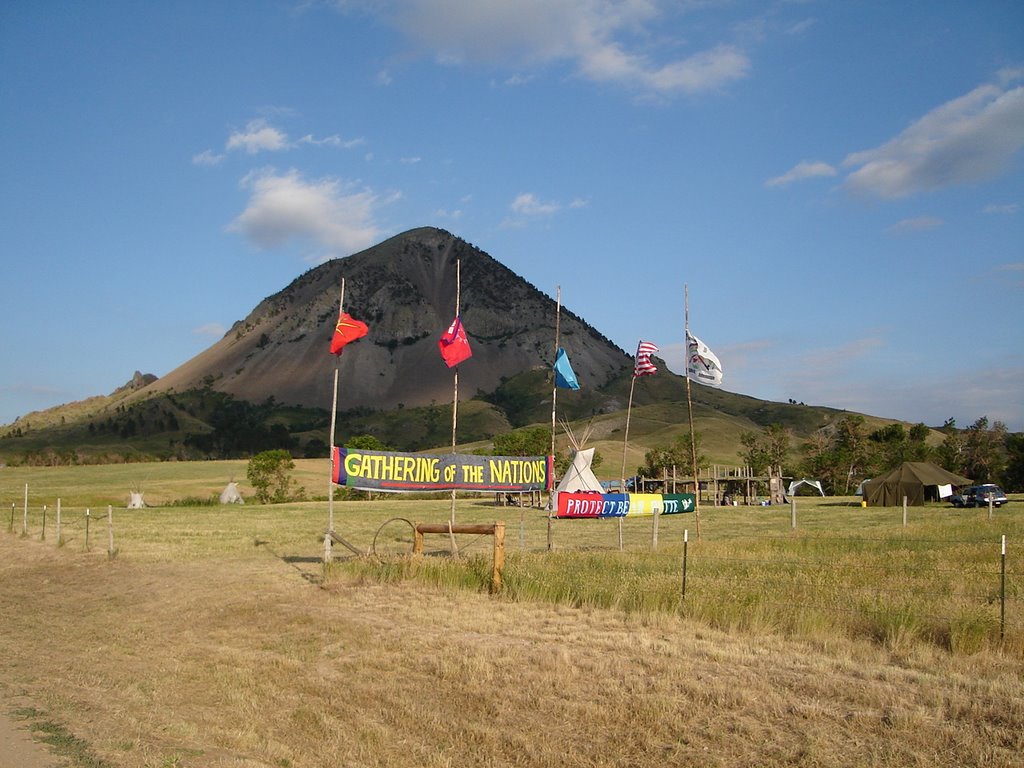
Sturgis SD. - The thunder creeps in everywhere: through library windows, through the walls of our tent at night, and into the cafe where we eat. Tens of thousands of engines roar in unison at the Sturgis motorcycle rally, where we have come to attend a prayer camp for the protection of Mato Paha, the holy mountain threatened by bars and party venues. We have come to meet with Native Elders, and have joined a prayer camp sponsored by the Northern Cheyenne.

During the rally, Sturgis South Dakota presents a picture of a culture utterly enthralled to the internal combustion engine; some motorcycle rally participants arrive on motorcycles with their tents and bedrolls, while others ride in van homes or rolling palaces towed by semi-trailers. The festival has grayed; the average age of the participants has topped fifty. But even the AARP of motorcycle rallies has plenty of beer, plenty of noise, and a very busy court and jail.

Saturday, August 04, 2007

A Cyclist Goes for a Long Drive...


Winner, SD. - If you read the cycling stories and the cycling advocacy here, the stories of travel by car we have posted in the last three days may make you wonder: why did we choose to drive? And does that mean my advocacy for cycling only means advocating easy cycling?
The work I have undertaken on behalf of Christian Peacemaker Teams requires travel to Rapid City South Dakota, two destinations not served by any public transit other than a bus service which runs on an irregular schedule, and an airline service. The work we plan to do requires mobility in a place where summer temperatures routinely get up into the mid forties (Celsius). We need to go to the area at a time when demand for accommodation pushes hotel prices for even budget hotels into the $200.00 per night range. We have to navigate changing circumstances, complex politics, and extreme, unpredictable weather. To do this work, we need a car. A bicycle touring champion might operate successfully on a bicycle in these conditions, though I doubt it, but I cannot.
All this means nothing to the Earth's carbon balance. Does the work we do justify itself to future generations, who will have to endure the atmosphere we leave behind? I believe it does. Nothing creates as much pollution as unconstrained conflict. I consider peacemaking a carbon offset. I believe the work we do to heal confrontations justifies the carbon we must expend.

Friday, August 03, 2007

The Journey is Our Home

Yesterday we left our house with the sun. Friends picked us up in the Christian Peacemaker Teams car, and we headed west for Chicago. Rebecca and Doug had meetings at the Chicago offices of CPT; we plan to attend a spiritual gathering on the subject of Mato Paha, the great sacred mountain of the Western Plains.

We had a long drive ahead of us for this first day: from Toronto through Chicago to Beloit in Wisconsin. Fortunately, our friends took turns with the driving, allowing me to catch up on sleep that the trip preparations had given me no time for. We took our friends to lunch in Ann Arbor at Zola's cafe, and treated them to the best waffles on this mortal Earth. Then we hit the road again, through the hills of southern Michigan and the northern Indiana, through the dark and slag-scarred mills of Gary Indiana, and so to the CPT American office on Chicago's West Side. There we rested and had dinner.

Whenever I see it, the scale of the American industrial landscape impresses me; where other cities have a lifting railway bridge, Chicago has a row of lifting bridges. The use of steel in places like Chicago also impresses me; where in Toronto we tend to build in square forms that have a spare functional beauty, American designers use more decoration, shaping even objects such as bridge supports into decorative shapes which look to me like tulip bulbs, and weaving decorations into bridge railings.

After dinner, and after leaving our friends behind, we headed west for the final phase of the day's journey: the trip to Beloit Wisconsin. We followed I-90 out of Chicago to Rockford, where crews repairing up the road reduced traffic to a monumentally frustrating crawl. And so to the inn and bed after a long day, a long leap at the start of our journey.

Thursday, August 03, 2006

Bear Butte

I have spent the past month in the northern edges of the spectacular Black Hills of South Dakota, at an encampment designed to defend a sacred mountain called Bear Butte, or Mato Paha to give it its Lakota name. Bear Butte sits at the northern edge of the Black Hills, where the hills give way to the high plains. It stands alone, a landmark to early travellers and a sacred place of worship to the Lakota, Cheyenne, Arapaho, and other Native American nations of the Great Plains.

Now, developers intent on a quick profit eye Bear Butte as a spectacular backdrop for giant party venues designed to serve the motorcycle rally centering in the nearby city of Sturgis, SD. Campgrounds and huge musical amphitheaters have begun going up, surrounding Bear Butte on three sides and destroying the peace, quiet, and beauty essential to a sacred place and a place of prayer. For a long time, the Lakota have pleaded with campground owners, civic officials, and motorcycle enthusiasts to respect their sacred site. When a bar owner and music promoter decided to call a new camping, party, and music complex “sacred ground”, the Lakota saw this as a clear insult. They decided to actively assert their right to pray at Bear Butte. Together with their allies, they have camped at the foot of Bear Butte, at a lodge owned by the Rosebud Sioux, and right next door to one of the biker bars and campgrounds. There they pray, bear witness, and there they will peacefully protest the desecration of this sacred place.

The Lakota have invited Christian Peacemaker Teams to accompany them in this work. Our roles include mobilizing the local Christian (and the wider) communities in defence of the right of the Lakota people to pray in peace.