Tuesday, August 02, 2016

An inadvertent Faustian bargain for cyclists?

The Ontario Highway Traffic Act says that cyclists have to ride in the right hand lane, but does not specify a position. It also requires motorists to pass cyclists with at least a meter of clearance. At the same time, it says that when passed, cyclists must move over and allow the overtaking vehicle to proceed. The law makes it unclear whether the cyclists must, as another part of the section on passing states, leave no more than half the road free, or whether the cyclist must move over regardless.

In the United States, the Uniform Vehicle Code, published by the National Committee on Uniform Traffic Laws and Ordinances in 2000, says the following:
(a) Any person operating a bicycle... at less than the normal speed of traffic... shall ride as close as practicable to the right-hand curb or edge of the roadway except.... When overtaking and passing another bicycle or vehicle.... When preparing for a left turn.... When reasonably necessary to avoid conditions' including but not limited to: fixed or moving objects; parked or moving vehicles; bicycles; pedestrians; animals; surface hazards; or.... a lane that is too narrow for a bicycle and a motor vehicle to travel safely side by side..... When riding in the right-turn-only lane.
In both cases, the law manages to say the bicycles should ride in the right hand lane and ride, or give way, to the right side of the road, except when they shouldn't. Conversely, cyclists can take the lane, when allowed to, under certain conditions.

For the past three decades, laws, practices and attitudes have evolved under pressure from environmentalists and cyclists. For much of that time, various people with an emotional or an economic stake in the current heavily motorized transportation system have attempted to resist this process. Laws in the process of change inevitably contain contradictory and unclear segments, as the legislature changes laws piecemeal.

As different legislatures change laws differently, it makes sense to expect the laws will evolve differently. In this case, the laws in very different jurisdictions have changed to the same effect: they all acknowledge the right of cyclists to take the lane where safety requires it, but they do so ambiguously. In all cases the application of the law depends on a judgement; in the case of the Ontario law, it requires a judgement about what the law means.In the case of the Uniform Vehicle code, a cyclists's right to take the lane depends on whether conditions require it; again, a matter of assessment.

The laws in Ontario and elsewhere have taken a particular shape: articulate cyclists with considerable personal resources, of the sort who tend to lead legislative campaigns, can take the lane with some confidence the courts will uphold, or at least permit, their actions. Meanwhile, the laws retain enough ambiguity to permit the police to push cyclists without the resources or time to study the law or prevail in court to the side of the road. I do not consider this a compromise cyclists should or can accept. As long as cyclists' right to ride in safety remains subject to ambiguities in the law, then some of us do not have the right to take the lane, which means none of us really do.

At a minimum, this means we haven't won the battle for the right to cycle, safely, and to choose the best road position. We need to say so. We need to keep pushing governments to remove all the qualifications in the law regarding our right to the road.

Saturday, July 30, 2016

Another comment on Black Lives Matter

By Fibonacci Blue from Minnesota, USA (Protesters gather for Black Lives Matter march) [CC BY 2.0 (http://creativecommons.org/licenses/by/2.0)], via Wikimedia Commons
By Fibonacci Blue (Wikimedia Commons)
Six months ago, Chris Lollie settled a lawsuit against the City of St. Paul Minnesota and the police department of that city. In response to a complaint by a private security guard that Mr. Lollie had sat in the wrong chair in an area open to the public, the police shocked him using an electric discharge device and arrested him.The courts first dismissed all the charges the police laid against Mr. Lollie, and subsequently cleared the way for his suit to go forward. At that point, to avoid the possibility of a larger damage award the city settled, although to the credit of the councilors who made the decision, they also considered the police had done wrong. As a member of council said: "I want to see our city make national news for many things. And this is not one of them."

Mr. Lollie took a cell phone video of his arrest, and the release of the video, as well as the subsequent discussion, took place just as the police shooting of Michael Brown in Ferguson MO came to international attention. Seeing the way the police treated Mr. Lollie, and discussing his arrest, led me to see the phrase Black Lives Matter as not simply the self-evident truth that the police should not shoot people with black skin, but that Black people have a right to live a full and whole life, lived in dignity, freedom, with a sense of possibility. I do not see Black Lives matter simply as a not shooting, but as upholding the dignity of the person.

Sunday, July 24, 2016

To my American friends..

Clinton at Planned Parenthood (cropped) By Lorie Shaull (Own work) [CC BY-SA 4.0 (http://creativecommons.org/licenses/by-sa/4.0)], via Wikimedia Commons
photo Lorie Shaull (Wikimedia)
From social media, I get a strong sense that some of you feel a deep and abiding disappointment about Democrat primary voters going for the "establishment" candidate, Hillary Clinton.

I don't normally like to tell voters in another country whom they should elect, but one thing makes the United States a special case: the largest thermonuclear arsenal on the planet. All voters, everywhere, vote for the people they think will do the best job for themselves, their children, and the unborn generations to come. When Americans vote to decide whom they will hand the keys of a 6,000+ megaton nuclear arsenal, they also vote on behalf of the 95% of people on Earth who do not get a vote in American elections, but can still die in a nuclear war.

Wednesday, July 20, 2016

How not to argue for the rights of cyclists

When cycling on streets and roads where motorists may have permission to operate their vehicles, cyclists have the right to decide our lane positions for ourselves. Human vision has a narrow acute range: the optimum resolution of our eyes covers just a few degrees. To cope with this limit, aviators train to scan the sky in small sections; without this training, surface motor vehicle operators focus on the road in front of the vehicle. Cyclists occupying the center of the lane have the best chance motorists will see and avoid us. Visibility plays a particularly critical role at intersections, and there cyclists riding to the side have the greatest chance of coming into conflict with motor vehicles.

There you have the safety case for cyclists riding in the center of the lane. It exists in tension with another safety imperative: separating traffic operating at different speeds, to avoid the need for sudden changes in speed and to minimize the consequences of an impact. Those two hazards: getting sideswiped by a driver passing too close and getting hit by a driver who sees us too late define the choices for cyclists. Taking all the risks and the known limits of drivers into account, it makes a lot of sense for cyclists to ride in the center of the lane when we don't have, at minimum, an adequate bicycle lane, and, preferably, a protected bike lane. Most of us who ride in North America can't count on bike lanes every where we go, or even most of the places we go. Most of us need to take the lane, and taking the lane serves us best when we do it without fear and without apology. At an absolute minimum, cyclists have, and ought to vigorously defend, a right to make our own choices about where in the lane to ride.


I ride in the center of the lane because I consider it safer. That covers it in three words: I consider it safer. John Forester and some of his supporters clutter the issue with irrelevant and frankly offensive detours from the single objective that matters: getting everyone from point 'A' to point 'B' alive and uninjured, notwithstanding the presence of two-tonne steel bombs.

Friday, July 15, 2016

#blacklivesmatter vs. #alllivesmatter: a different perspective

By Fibonacci Blue from Minnesota, USA
[CC BY 2.0 (http://creativecommons.org/licenses/by/2.0)],
 via Wikimedia Commons
To judge by my facebook feed, just about everyone I know who forwards thoughts about the original #blacklivesmatter and the rejoinder #alllivesmatter see the difference as one of urgency. The vast majority of comments I read use an analogy of a building on fire or a child who got left out at dinner. By this analogy, black lives don't matter more, but black people, at least in the American context, have a more urgent need for justice right now.

I agree with this analogy, but I can see other ways of looking at the issue as well. A hashtag, after all, has some flexibility; we can see it in many different ways. And by seeing the hashtag #blacklivesmatter in a slightly different way, I have also come to see the problem with the attempted retort #alllivesmatter in a different way as well.

Imagine the hashtag #blacklivesmatter, not as a plea or as a proposition. Imagine it as a simple statement that we all long ago signed onto. In this light, the hashtag contains an accusation: the lives of Black people matter; you know it, I know it, we all know it, but our society, and particularly our justice system do not act according to our understanding. The power of the #blacklivesmatter hashtag stems from our recognition that our actions and the behaviour of our institutions do not reflect our stated ethics: therefore, #alllivesmatter will always embody a weak response, a feeble denial. Simply acknowledging the phrase "black lives matter" as a statement that calls for a response shows that at some level those who respond understand the problem exists. If black lives matter did not call our attention to a real problem, we would respond with "of course", rather than with "all lives matter".

Thursday, June 16, 2016

Pulse nightclub Orlando. Rest in peace, rise in glory

Stanley Almodovar III, Amanda Alvear, Oscar A Aracena-Montero, Rodolfo Ayala-Ayala, Antonio Davon Brown, Darryl Roman Burt II, Angel L. Candelario-Padro, Juan Chevez-Martinez, Luis Daniel Conde, Cory James Connell, Tevin Eugene Crosby, Deonka Deidra Drayton, Simon Adrian Carrillo Fernandez, Leroy Valentin Fernandez, Mercedez Marisol Flores, Peter O. Gonzalez-Cruz, Juan Ramon Guerrero, Paul Terrell Henry, Frank Hernandez, Miguel Angel Honorato, Javier Jorge-Reyes, Jason Benjamin Josaphat, Eddie Jamoldroy Justice, Anthony Luis Laureanodisla, Christopher Andrew Leinonen, Alejandro Barrios Martinez, Brenda Lee Marquez McCool, Gilberto Ramon Silva Menendez, Kimberly Morris, Akyra Monet Murray, Luis Omar Ocasio-Capo, Geraldo A. Ortiz-Jimenez, Eric Ivan Ortiz-Rivera, Joel Rayon Paniagua, Jean Carlos Mendez Perez, Enrique L. Rios, Jr., Jean C. Nives Rodriguez, Xavier Emmanuel Serrano Rosado, Christopher Joseph Sanfeliz, Yilmary Rodriguez Solivan, Edward Sotomayor Jr., Shane Evan Tomlinson, Martin Benitez Torres, Jonathan Antonio Camuy Vega, Juan P. Rivera Velazquez, Luis S. Vielma, Franky Jimmy Dejesus Velazquez, Luis Daniel Wilson-Leon, Jerald Arthur Wright

Editing the list of names of people killed at Pulse nightclub in Orlando last Saturday brought home to me how long a list of names forty-nine victims makes.

Wednesday, June 15, 2016

Would simplifying the laws help?


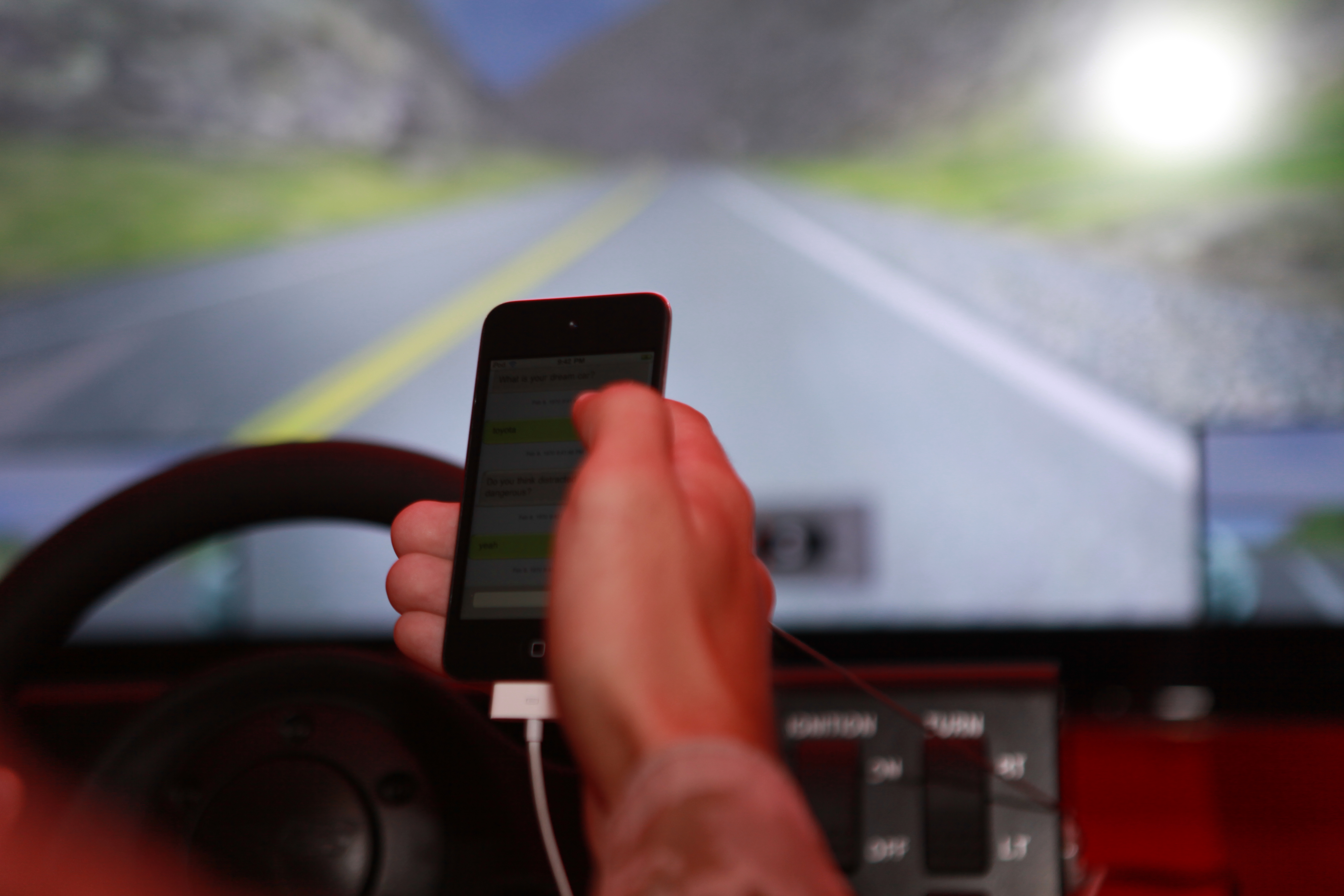
 A participant tests a text-while-driving simulator at the
Distracted Driving event aboard Marine Corps
Air Station Miramar, Calif., Nov. 4.
Ontario has a the provincial law on distracted driving. What would happen if we repealed it? The criminal code of Canada already has a section (249) prohibiting the operation of a powered vehicle or aircraft in a manner that endangers the public. Does anyone not think tooling down the road while taking a selfie, texting, or talking on a hand-held device endangers the public? Creating a special category of "distracted driving" allowed the legislature to create special (specially lenient) penalties. Dangerous driving carries a maximum sentence of five years in prison. Distracted driving carries a maximum sentence of a thousand dollar fine and three points on your license. The real distinction, however, kicks in if a distracted driver kills someone. Provincial laws do not increase the penalties for driving offences when a death or bodily harm results. If the province didn't have specific legislation on distracted driving, but rather a regulation requiring prosecutors to pursue charges of dangerous driving against distracted drivers, driving into someone and killing them while answering a text could mean up to a up to fourteen years in prison.

Section 252 of the criminal code of Canada prescribes penalties for leaving the scene of an accident. What if we replaced it by a law that made it a criminal offence to hit someone with a vehicle and injure or kill them? The law could allow drivers to present, as an affirmative defence, that they had operated according to the law and prudently given the conditions, and that the crash came about because of factors they could not control. A driver who left the scene of the crash would only escape criminal liability if they could escape detection indefinitely. Drivers who left the scene of a fatal crash would find it impossible to explain their behaviour, and the courts would convict and sentence them for the essential offence: killing someone with a motor vehicle.

Legal simplification only works if the courts will apply common sense when enforcing the law. It makes sense that when manually controlling an automobile that covers twenty meters every second, a person taking their eyes and concentration of the road for the thee seconds it takes to send a text endangers everyone within sixty meters, but how many dangerous driving charges did the police lay against texting drivers before the province passed the distracted driving law?

As long as we stay with the social convention that we will never require drivers to apply even the most rudimentary logic, that no act behind the wheel violates the law unless the law specifically prohibits it and a police officer witnesses it, we will always need more and more detailed laws. The penalties these laws prescribe will always fall between the need to deter and denounce truly dangerous behaviour, and the impulse to keep motoring available for everyone. We have to live with that situation, at least for now, but that does not mean we should accept it. In principle, fewer laws, backed by a social and legal consensus that we need not pay our road tolls in blood and that we ought not to condone behaviour that endangers other people, would serve us much better.

Monday, May 09, 2016

The heart of the matter

In a previous post, I wrote about the so-called "Overton window": the conviction that policy proposals have a simple linear value; that setting them out, ordered, on a line makes it possible to define a range, or a set defined in linear order from a minimum to a maximum value (the "window") that opinion makers empowered to do so will deem acceptable.

This linear view has no relation to the complicated reality of politics. Using it distorts and even corrupts approaches to politics in many ways: ultimately, treating politics as symbols with single ordinal values offers considerable scope for attempts to control the process.


Saturday, May 07, 2016

Daniel Berrigan, presente

Conventional movies have contained few genuinely moving, as opposed to sentimental moments. One of the most moving occurred at the beginning of the film The Mission with Jeremy Irons, a story of the involvement of the Jesuits with the Guarani people. Near the beginning of the film, three Jesuits walk toward the viewer coming over a rocky knoll. Two of these are actors dressed as Jesuits: the third is Dan Berrigan.
By Thomas Good GFDL

While protests against the American Imperium and its exploitation and war would inevitably have arisen, Dan Berrigan had a profound influence on the shape they took. His embrace of a non-violent, ethically based resistance to war and domination helped inspire activist movements of the past generation. He followed the example of Jesus, whose ministry, by the world's standards, ended in the utter failure and disgrace of the cross. By separating the pursuit of truth and ethics from fame, from success, from power, Dan Berrigan helped create a movement that political defeat could not stop and that darkness could not stifle.

He is at peace now. Let light perpetual shine upon him. Let us who remain continue the great work he has nobly advanced.

Politics through the window (please, just not Windows 10...)

Politics, as an art, a practice, and discipline and a commitment has one real purpose: to make good policies for the peace, welfare, and just ordering of the polity. Politics aims to find solutions that allow us, as disparate, imperfect people, to live good lives together in a functioning community.

It also makes for terrific theatre.

Wednesday, May 04, 2016

Wait, what?

It looks like we started a trend.

Just over a week and a half ago, a driver came up Jane Street in West Toronto and managed to jump the curb and hit a small apartment building. The force of the crash threw the engine block halfway across the street, and shrapnel sprayed the fronts of buildings 15 meters away from the crash site, denting window mouldings and chipping stucco. The passenger of the car died, the collision damage made the building unstable and the city evacuated the residents.

One collision such as that makes sense: freak accidents happen. Then, a little less than a week later, another driver crashed into a convenience store at Harbord and Bathurst, in the middle of Toronto's downtown.

Just this week,  someone else drove an SUV into a building in the Beach, a neighbourhood in the city's east end. This time, the crash killed an occupant of the building: an elderly woman preparing for a morning dance class.

Really, Toronto motorists? Seriously? I get that some things come in epidemics, but driving cars into buildings? Some people really need to ditch the car or the truck and start riding a bus.

Tuesday, May 03, 2016

A betrayal wrapped in an oxymoron

By Gage Skidmore (Flickr.com) CC BY-SA 2.0, via Wikimedia Commons
By running for president of the United States, Donald Trump has exposed a good many open wounds. The phrase used to describe one of these sums it up succinctly, but not neatly. Like origami, the concept opens into multiple dimensions; the more you pull on it, the more it reveals. White working class: suddenly, the phrase appears in everyone's articles, an all purpose location for the appeal of one Donald Trump, and much more beside.

The phrase explains without explaining; it explains not in the sense that the words themselves carry meaning, but in the sense that the words "white working class" serve to trace the lines of deep scars or unhealed fractures in our society. Start with the word order: the white working class. The syntax suggests a single mass, like a vast white shag carpet covering several American states. The opposite phrase, working class African Americans, suggests a single description applicable to multiple individuals. Specifically, the phrase speaks of African Americans who belong to the working class, people who work for wages and who need to work for wages to support themselves. Working class African Americans also belong to a larger set: the working class generally, made up of people of all ethnic varieties, all nationalities. The phrase white working class, on the other hand, completes a definition not of multiple persons but, somehow, a single phenomenon.

Monday, May 02, 2016

Seven reasons to want more people cycling

Every cyclist should want more people to get on a bike. Wherever, however, whenever you cycle, you should welcome two-wheeled, human powered company on the road. The reasons for wanting more cyclists include:

  1. More cyclists means a healthier society. A huge body of evidence indicates that using a bicycle for transportation on a regular basis adds as much as two years to the average life span.
  2. More cyclists means a happier society. Regular activity counters depression.
  3. More cyclists means a smarter society. Regular physical activity, including cycling, improves alertness.
  4. More cyclists means less local pollution from cars.
  5. More cyclists means more provision for cyclists: everything from more bicycle parking to bicycle racks on buses.
  6. More cyclists means motor vehicle operators expect cyclists, look for cyclists, adapt their behaviour to account for the presence of cyclists on the roads.
  7. More cyclists cut into the sense of immunity that many motorists expect. In a community where the vast majority of people commute to work, leisure, shopping and even the gym by car, motorists know that other motorists will investigate and adjudicate any crash they get into. In a community where cycling plays an important role in transport, the motorist can expect that at least some of those who judge their behaviour will have no sympathy with those who choose to operate motor vehicles unsafely.

From error to error

A concerned student at University of Missouri
Photo by Mark Schierbecker (Own work)
via Wikimedia commons CC BY-SA 4.0 
Rod Dreher recently posted a web log entry in which he noted that the University of Missouri has fallen on some hard times. He attributes that to what he calls "craven appeasement" by the university of the protests that broke out at the university last fall. Mr. Dreher notably repeats the word "appeasement" twice and "cowardice" once, but does not allude to right or wrong, either in the ethical or the practical sense. He attacks the university, in other words, simply for an abstraction: abdicating authority.

The original charge of appeasement had a moral basis: the conviction, horrifyingly proved correct by subsequent events, of the wickedness of Hitler and the Nazi regime. At least in the case of the Munich agreement, the betrayal of the Czechoslovakian democracy compounded the immorality of appeasing Hitler. Whatever your opinion of the University of Missouri administrators, they did not commit anything like appeasement in this sense. If anything, the record of offences weighs against the powers that be of Missouri: whatever their faults, the student protesters do not carry the moral weight of one of the most inhumane slave economies on record, or of a terror state designed to keep African Americans "in their place". Nor did the protesters invent the carceral culture that has millions of Americans locked up for ideology and profit. Indeed, their protests against this plunder represent a genuine hope for renewing the American project.

Sunday, April 10, 2016

Grace notes and missed opportunities

Rob Ford has died. Rest in peace.

After a pause, a very brief pause, in the interests of decency, the negative assessments of Rob Ford's performance as mayor have started. And indeed, Rob Ford's tenure in the mayor's office was a disaster, most of all for Rob Ford. Edward Keenan's got it mostly right. Heck, nearly everybody has it right. Rob Ford's talents, his outlook, did not match the skills and the perspective a mayor needs.

Rob Ford believed in servant government. Politicians should believe in servant government. If more politicians really wanted to serve the people, instead of socking away money in off-shore tax havens, we wouldn't just have better government, we'd have a better world. Rob Ford wanted to solve people's problems. He wanted to serve as the kindly scullery maid handing leftovers out the back door. He wanted to answer phone calls and get potholes filled. Despite his lapses, he did a good job as a councillor.

Tuesday, April 05, 2016

Four words closer to the safety of life

In one of his more recent screeds against cycling, Jim Kenzie, the Star's car reviewer, wrote this chilling sentence: "We still kill more pedestrians and motorists on Toronto roads than we do cyclists."

We shouldn't kill anybody. I'll say that again: we shouldn't kill anyone. We should never accept death as a price for anything. Any violent death, any injury, in the course of any activity means that something went wrong and needs correction. When it comes to automotive technology, and the million odd deaths it causes world-wide, we need to do a lot of correcting. We need a safety culture.

The safety cultures I know best, marine and aviation, have four defining principles, summed up in four words: priority, transparency, authority, and accountability.

Start with priority, as in the safety of life has absolute priority. Nothing trumps the word unsafe. Not convenient, not fast, not efficient, not cost-effective. Having a deadline does not justify an unsafe act. Money does not justify a lack of safety.

Saturday, January 09, 2016

Theology as Logos...

The American eangelical school Wheaton College has apparently decided to fire one of their professors, Dr. Larycia Hawkins for stating that Christians and Muslims pray to the same G-d. Wheaton claims that this statement violates their profession of faith, which the institution requires all staff and students to assent to. The institution has come in for criticism: some strong, and some balanced between support and criticism. Some of the support they have received makes specific reference to the need for institutions of learning committed to a specific viewpoint to ensure all the scholars adhere to that viewpoint; to, as Rod Dreher's comments put it, "police their theological boundaries". Whatever the value of setting limits to enquiry in a religious school, doing so carries a risk: that the school may end up enforcing an logically contradictory position. You can't alter a logical conclusion by firing someone for following it.

Start with an element of basic Christian theology: G-d as universal, the Creator of all things. We know (and can prove) that by its very Nature language does not and cannot encompass the universal (Gödel's proof). Therefore, as Paul (1 Corinthians 13:12) says:
...now we see in a mirror, dimly, but then we will see face to face. Now I know only in part; then I will know fully, even as I have been fully known.
It therefore follows that if we pray to G-d simply as we conceive G-d to be, we necessarily pray to an incomplete idea of G-d. As  C. S. Lewis put it, we must, logically, pray to G-d as G-d knows G-d's self to be. If we do this in humility, acknowledging our inadequacy to fully conceive of G-d but directing our worship to the great "I am" (Exodus 3:14), and if Muslims do the same, then they and we necessarily pray to the same G-d. And if we do not, if we pray to our conception of G-d, then we can only hope in humility for G-d to bridge the inevitable gap between the limited concepts in our minds and the transcendent reality. And if Muslims do the same, do we dare ask that G-d not grant them the same mercy?

Friday, December 25, 2015

All I want for Christmas...

is a safety culture on Ontario's streets, roads and highways. And some respect for vulnerable road users would be good, too.

Thursday, December 24, 2015

These aren't the droids you're looking for -- and by the way, this is the best movie ever

It's probably just me, but somehow the rave reviews for "The Force Awakens" have a whiff of jedi mind tricks about them. It's not that it's a truly bad movie. Certainly, if you compare it with "Phantom Menace", it's a real accomplishment. But it's been called the best movie of the year, which seems just a little excessive in a year that saw the release of "Room" and "Spotlight".

For those who go to movies looking for spectacle, "The Force Awakens" delivers. For those who want to see plot twists, this movie will more than satisfy. If you want to see moments of convincing acting between the explosions, it comes across as well. For those who want to see truly coherent, truly excellent writing: see "Spotlight", or see "Room".

In his book "The Empty Space", the great English theatre director Peter Brook wrote about the disconnection between plays that described inner lives and plays that addressed the great sweep of world events. Brook points to the Elizabethan theatre as proof that writers could address both interior thoughts and feelings and world events, exposing the conflicts and interactions between the fears and hopes of individuals and the great events of the world. Perhaps Star Wars aims to do the same thing on a mythic scale, but it misfires badly.Star Wars has a red shirt problem. The first movie of the series, in 1977, began with the destruction of the planet Alderan.

All story-telling risks a kind of narcissism: telling a story inevitably means telling it from a particular point of view, and the listeners come to understand, and to that extent sympathise with, that view. Some story-tellers resist, making a conscious effort to remind their hearers that people outside the circle of the story also matter. Other storytellers happily capitulate to the limits of the form, even turning effect into ideology. Star Wars explicitly defines some of its characters as "chosen", some as auxiliaries placed by fate in the orbit of the chosen, and the vast majority as grist for the cosmic grinder. But this juxtaposition of the few who matter with the many who do not creates jarring inconsistencies in the heart of the story. At the end of Return of the Jedi, the film clearly presents Annakin Skywalker as fulfilled and redeemed, together with Obi-wan and Yoda which leaves the audience to wonder where in that afterlife the inhabitants of Alderan have got to.  "The Force Awakens" does not change this; it doubles down on the anonymous slaughter.

The problems with "The Force Awakens" start with, well, the force. An invisible, quasi-religious and very loosely defined principle associated with a set of abilities, mostly telepathy, the ability to manipulate others, and telekinesis, the Start Wars movies describe it as a grace somehow passed on by heredity. The force, in fact, provides a continual deus ex machina for the series, and particularly for the current film. The film depicts one of the principal characters as a scavenger, scratching out a subsistence living selling parts scavenged from the debris of space battles of a generation ago to an exploitative and oppressive junk dealer. Yet this character goes on to display excellent piloting and combat skills, skills that take decades to master and in fact act as the hallmarks of military aristocracy. Who taught this character these skills? Why would they? It should not surprise any viewer that the film makes it abundantly clear that the force is strong in this one. The films express a vision of profound inequality, and "The Force Awakens" does not change this.

Some of the best works of literature and drama to describe great historical events and movements have done so from the point of view of a random participant, as "Casablanca" tells the story of the Second World War, or from the point of view of the victims, as "One Day in the Life of Ivan Denisovich" or "Johnny Got His Gun" do. The protagonists of these stories represent the millions of people who went through the same experiences. Other accounts tell the story of major events from the point of view of people who happened to make specific decisions that had a profound impact. The choice of protagonist matters, and in Star Wars, the choice of protagonists, by an impersonal blessing from the universe passed on in the family line, contradicts the ostensible theme of the series, the struggle to preserve, then the struggle to restore, then the struggle to maintain a democratic state. The writers of Star Wars do not manage this tension well. "The Force Awakens" is spectacular; it has good acting between the blasts, but it does not tell a compelling story.

Sunday, November 15, 2015

Cultural appropriation and the millennial environment

The recent protest at Yale University over issues of cultural appropriation and Halloween have received support, analysis and condemnation. Responses opposing the protestors run the gamut from thoughtful concern about free speech to indignant clucking.

Much of the thoughtful criticism focuses on the supposed "intolerance" of the protesters, asking what happened to the legendary free speech protests of the 1960s. Some of the writers objecting to these protests seem to think objections to racial caricature, at Halloween or any other time, represent a new low in public support for free speech. That would probably come as a shock to the Nuremberg tribunal, who found the vicious anti-semitic caricatures of Der Sturmer had helped fuel the hatred that drove the Nazi persecution and mass murder of Europe's Jewish population. The court sentenced the publisher of Der Sturmer to death for crimes against humanity. Free speech has always had limits, and most Western countries acknowledge that in a society that aims at tolerance and diversity, incitement to hate lie falls outside these limits.

To understand why student complaints about the use of cultures in Halloween often seem to focus on practices that do not seem hateful, it helps to understand the environment the millenial generation has grown up in. The Internet has shifted the context in which today's students experience restrictions on speech. The power of the Internet has made the actual repression of information and opinion very difficult, except for extremely authoritarian governments willing to endure considerable self-inflicted harm. Students today have never lived in a world where censorship of ideas can plausibly come from an American civil servant or a judge. Instead, they have spent their lives in the world of the DMCA, where expressions get blocked not by laws but by licenses, not by bureaucrats but by lawyers, not by state power but by private claims of ownership over ideas. The controversy over cultural appropriation in Halloween costumes involves not free expression but property.
"MGD06JesusSaysBuyMoreArt" by Infrogmation - Own work. Licensed under CC BY 2.5 via Commons - https://commons.wikimedia.org/wiki/File:MGD06JesusSaysBuyMoreArt.jpg#/media/File:MGD06JesusSaysBuyMoreArt.jpg
Connor Friedersdrorf quotes the offending email by Erika Christakis: "Is there no room anymore for a child or young person to be a little bit obnoxious... a little bit inappropriate or provocative or, yes, offensive?" That looks to me like a naive and nostalgic view. In Halloween celebrations of the 1960s and 1970s, parents whipped up costumes for their children, Halloween decorations were made at home, and students pulled sheets of their beds for toga parties. Some parents still make costumes for their children, but Halloween today is a multi-million dollar business. Stores pop up in major cities in September and October, selling multitudes of ready to wear costumes. These costumes come with design copyrights, trademarks, even business method patents. The only people who do not get to make claim on this revenue stream are the people who created and maintain the living culture that gives many of these costumes their meaning. Cultural appropriation is not kids being transgressive; it is yet another an example of big business using the powerless as raw material to make a buck. Moreover, it is one means of turning that many things appropriated from the powerless into cash that individual students can choose not to participate in.  The email from Erika Christakis advised students offended by a costume "...if you don’t like a costume someone is wearing, look away, or tell them you are offended. Talk to each other." That misses part of the point. Costumes are big business. By the time a student puts on an offensive costume, the exploiters have rung up another sale.

Saturday, November 14, 2015

Pray...

for the people of France mourning loved ones. And the people of Lebanon. And Syria, Iraq and Russia. Pray for everywhere terrorism leaves its ugly imprint.

Wednesday, November 11, 2015

The 11th day

of the eleventh month, the guns of the war to end all wars fell silent. The millions of the dead in that war included my great uncle Launcelot Cumpston. Eleven years after the end of that war, my father was born. I was born eleven years after the Second World War; a war in which my cousin John Cox died.

We frequently commemorate the war dead with the phrase "lest we forget". In its original context, the phrase did not refer to the need to remember the dead and the sacrifice they made. It appeared in Rudyard Kipling's poem recessional as a refrain: it calls us to remember that power politics and military might will not keep us safe.

God of our fathers, known of old—
Lord of our far-flung battle line—
Beneath whose awful hand we hold
Dominion over palm and pine—
Lord God of Hosts, be with us yet,
Lest we forget—lest we forget!

The tumult and the shouting dies—
The Captains and the Kings depart—
Still stands Thine ancient sacrifice,
An humble and a contrite heart.
Lord God of Hosts, be with us yet,
Lest we forget—lest we forget!

Far-called our navies melt away—
On dune and headland sinks the fire—
Lo, all our pomp of yesterday
Is one with Nineveh and Tyre!
Judge of the Nations, spare us yet,
Lest we forget—lest we forget!

If, drunk with sight of power, we loose
Wild tongues that have not Thee in awe—
Such boastings as the Gentiles use,
Or lesser breeds without the Law—
Lord God of Hosts, be with us yet,
Lest we forget—lest we forget!

For heathen heart that puts her trust
In reeking tube and iron shard—
All valiant dust that builds on dust,
And guarding calls not Thee to guard.
For frantic boast and foolish word,
Thy Mercy on Thy People, Lord!

let us remember all the men and women who served in war and peace, those who stood guard and those who bound up the wounds, those who gave their lives in battle to resist aggression, and those who laid down their lives to witness that there is another way.

Above all, let us honour the memory of those who died without complacency. I believe the near future must include a day on which we can say: here ended war. I believe that if that day does not come, then a day will come, although nothing will ever mark it, when humanity ended. And I honour the sacrifices made by brave men and women in the armed services of our country.

Sunday, August 30, 2015

NDP and deficits

Writing in the Progressive Economics Forum, Louis-Phillippe Rochon denounces Thomas Mulcair's stated intention to avoid running a deficit. He pronounces himself shocked, shocked that Mr. Mulcair would ever suggest that deficits and debt make it impossible for governments to do good things for those they govern. He writes:
But in embracing balanced budgets, Mulcair has also endorsed all the right-wing rhetoric and lies that come with it. On the campaign trail, Mulcair has said in response to Trudeau’s promise of infrastructure spending, “I am tired of watching governments put that debt on the backs of future generations.” Later, he said “Mr. Trudeau seems to have the same approach as Mr. Harper – they both want to live for today and let tomorrow take care of itself … There’s a reason why we want to be good public administrators with balanced budgets, because if we’re not, then we’re not going to be able to have the types of programs that we all believe in going into the future.”
Historically, running a deficit without a just tax structure simply creates more debt, which rich people and corporations buy because poor people can't afford to; this requires governments to pay interest, which the poor pay for and which rich people and corporations collect. We have also reason to believe that citizens pay more attention to what governments spend  their money on when they have to actually hand it over as taxes, rather than watch the numbers add up on a debt clock on the web. Experience over the last five decades doesn't do much to support borrowing money as a means of building a durably just society. Infrastructure projects, public benefits, and economic stimulus without a strong, just and sustainable base of fair taxes can end up in the sorry mess the Greeks find themselves in, or the wildly irresponsible bank bailouts the Americans and others engaged in at the outset of this decade. Above all, I see no way to build a just society on injustice,whether you borrow money to do it or not.

And that, rather than the nicer points of public finance, explains why I, unlike Dr. Rochon, plan to give Mr. Mulcair and the NDP as much support as I can. Unlike Justin Trudeau's Liberals, the NDP voted against Bill C-51; unlike the Liberals, the NDP has promised to repeal it as soon as they get into power. And that matters, because C-51, effectively declares open season on First nation communities trying to protect their culture, land and rights. If, as they have said they will, the Liberals retain any part of a law that makes it easy to trample the rights of people Canada already has a shameful history of abusing, they will run a moral deficit far worse than any numbers in a financial ledger, and they might as well build their infrastructure projects on sand.

Thursday, July 23, 2015

...a different appropriation

Consider this thought experiment.

In front of you you is a large blue button. You have only to push it, and technologies for efficient energy production, large scale urban agriculture, and efficient recycling and recapture of metals and materials will appear on a mass, commercial scale. Fibre production will come from massive and energy efficient grow-ops. Recycling will replace mining, and the agriculture that feeds the cities will be relocated to high-rise, high efficiency urban hydroponic farms, and fossil fuel extraction will end. With little to no industrialization pressure, indigenous cultures, and indeed anyone willing to live simply off the land will have the majority of the planet's surface to themselves. The First nations of the Western Hemisphere, for the first time since Columbian contact, will have an opportunity for real freedom.

There's a but.

If you push that button, the patents for all this technology will be owned by Exxon, Haliburton, GE, GM, IBM, Microsoft, Monsanto, and Nestle. Indigenous people will be free and outside this system, but the rest of us, those who want IPads and Internet, gaming, and Facebook will end up more deeply entwined than ever in neo-liberal corporatist culture. With the new technology, this culture and its owners would be more successful and more powerful than ever before.

The blue button aims to separate our commitment to specific matters of justice from our sense of what the world we want to live in looks like. If we push my imaginary blue button, it would end the oppression and dispossession of  the people of the land here in the Western Hemisphere, and many of us are committed to doing just that. That it would also cement the prosperity and the power of people many of us hate and fear is at most a secondary matter. To paraphrase Abraham Lincoln: if I could free oppressed First Nations by eliminating neo-liberal culture, I would do it. If I could free oppressed First Nations by not changing the neo-liberal culture at all, I would do that. If I could fee oppressed First Nations by eliminating some aspects of neo-liberal culture and leaving others the same, I would do that.

Many of us deplore the appropriation of the cultural artifacts of oppressed peoples by mainstream culture, ranging from actual religious symbols to gestures, but observing the dialogue on the Left today I have to wonder how many of us engage in a more subtle appropriation: using the urgency of the struggle for First nations rights, the struggle for the dignity and safety of the African communities in North America to promote our own vision for the future of society. If we work and fight for a world where Black lives matter, or First nations are masters of their own fates, what happens to neo-liberal culture in the process only matters to the extent that neo-liberal principles actually affect the lives and dignity of the people we ally with. Insist on freedom and justice first, and we will see what happens to the Nestles and Monsantos of the world.

Tuesday, February 17, 2015

Fashionable political absurdities...

David Frum recently published an article in Atlantic Monthly, with the following interesting statement:
The Obama people, not being idiots, understand very well that international terrorism possesses an overwhelmingly Muslim character. In Europe, where attention is so focused now, the great majority of the most lethal terrorist incidents of the past 15 years have been carried out by people professing to act from Islamist motives. 
Peter McKay, Canada's Justice Minister, recently illustrated the problem with this thinking, although he did so unintentionally. In his recent statement on the conspiracy to commit random mayhem in Halifax, Mr. McKay denied the conspiracy had any links to "terrorism". Since then, evidence has surfaced of a motive: the social media presence of at least some of the accused conspirators reveals a far-right wing orientation. Denying that a plot to commit random violence with no possible motive except for politics only makes sense in the context of a trope that effectively defines political violence as terrorism only if committed by Muslims.

Consider another example, the largest mass casualty act of political violence in the last twelve calendar months to take place in the geographic confines of Europe: the shooting down of Malaysia Airlines Flight 17 over the Eastern Ukraine. To the extent this attack involved any Muslims at all, it involved them as victims. It caused 298 deaths, by a long way the greatest number of deaths from an act of political violence last year, and for some time before. So why does neither David Frum nor the sources he quotes at least acknowledge this as a terrorist act? Because, by the definition in effective use by his contemporaries, it doesn't qualify. Muslims didn't do it.

Given the winds of political fashion, shorthand expressions that conceal absurd assumptions come and go all the time. These tropes only really matter when someone attempts to use them to establish a point of fact, and ends up seduced into stating something seriously out of line with the facts.

Saturday, February 07, 2015

Halfway around the world...

I recently stumbled on an example of the way an untruth can make it halfway around the world while the truth is getting its boots on.

On a comment section in Atlantic recently, I ran into the following claim about the creeping Islamic influence in "Western" societies:
...Islamists have brought about women-only classes and swimming times at taxpayer-funded universities and public pools; that Christians, Jews, and Hindus have been banned from serving on juries where Muslim defendants are being judged, Piggy banks and Porky Pig tissue dispensers have been banned from workplaces because they offend Islamist sensibilities. Ice cream has been discontinued at certain Burger King locations because the picture on the wrapper looks similar to the Arabic script for Allah, public schools are pulling pork from their menus, on and on...
When I asked for sources for these claims, another person posting on the same thread pointed out that virtually exact copies of this same statement have appeared as cut and paste jobs in many site comments. After a Google search I tracked down the source of this boilerplate: a thriller by Brad Thor called The Last Patriot. Amazon describes it as the story of a US Navy Seal turned Homeland Security operative, searching for a secret way to halt militant Islam. That may or may not provide a diverting read. But when a sentence or two, lifted from a work of fiction, appears in dozens of comments as fact, it has the potential to distort discussions of public policy that matter.

This encounter with Internet fiction repackaged as fact has reminded me not to assume the assumptions that produce legislation such as the Conservatives' recent security bill have any basis in fact. 

Sunday, January 11, 2015

On solidarity

Forget Charlie Hebdo for a moment. Start somewhere else. Consider a little community in Colombia, Las Pavas. The people of Las Pavas have a small cooperative agrarian community. Their lifestyle apparently suits them. Unfortunately, their land has attracted the attention of an international company that wants to extract palm oil. The people of Las Pavas are trying to say no to the exploitation of their land, and to the corrupt and violent processes by which an international company has attempted to take it from them.

If bullets can answer words, the people of Las Pavas, and with them a hundred other communities: indigenous people, the poor, or even simply people who choose peace, have no chance whatever.  The greed of the neoliberal order and the obsessions of the consumer culture will answer words with bullets without a single thought if they can get away with it.In fact, none of us have any realistic possibility of resisting the violence of our culture with violence. We organize, we protest, we speak, we persuade, and we cannot do any of these things effectively if a bullets can answer words.

That explains why je suis Charlie, and why je suis Charlie matters so much.

Not everyone agrees: some of the most quoted pushback has come from Jacob Canfield of the Hooded Utilitarian. Mr. Canfield makes the point that free speech does not free Charlie Hebdo from criticism. His criticism focuses on the way he considers the editors Charlie Hebdo failed to navigate the distinctions between the places in the world, such as Europe, where some Muslims suffer oppression, and the places some Muslims oppress others. Whatever the merits of that argument, it does not change the reality that two men with Kalashnikovs attacked a satirical magazine and killed eight journalists and cartoonists, as well as police officers protecting the offices. In a wholesale and brutal fashion, the gunmen answered words with bullets. A brief look at the firepower available to those governments committed to the neo-liberal politics and economics makes it extremely clear that the poor and powerless in the world will suffer most if the murders at Charlie Hebdo go unanswered.

Wednesday, December 10, 2014

I remember...

as a child watching the first runs of Mel Brooks's Get Smart with my parents. In one of the episodes a character mentioned torture, and my mother said the American forces would never use torture.

My mother did not indulge in illusions about Americans. She never saw the United States with awe or reverence or as the exceptional and unique nation many Americans profess to see. She saw a nation among all others, home of Janas Salk and Bull Connor, Martin Luther King and George Wallace, John F. Kennedy and H. L. Hunt. She saw a country with manifold, even brutal flaws, a country capable of great good and great evil, a country where, in that moment, the good outweighed the evil. Above all, she saw a country which stood for something, something that included a code of conduct. And that code of conduct simply excluded torture.

I refuse to believe that country no longer exists. I believe many, many Americans still hold to and live the basic American propositions about the fundamental dignity of human beings, and would never engage in. or condone, torture. The American Empire may have grown over the American Republic, but it has not devoured the American Republic. Yet when I read long discussions in comments on the recently released US Senate report of CIA torture, discussions focussed entirely on the question of utility, of whether torture works, I cannot shake the conclusion that my mother would find many contemporary Americans deeply dsappointing.

Tuesday, December 09, 2014

Black lives matter

For Canadians tempted to get smug about the American legacy of slavery, let me add: First Nations lives matter as well.

The incidents in the United States between African Americans and the police have piled up lately in a particularly sobering way. A police officer in Ferguson MO. shoots an unarmed student. A police officer in Staten Island chokes a man selling for loose cigarettes. Officers shoot and kill a shopper in the middle of buying an air pistol and a child playing with a toy. A police officer stops a motorist, orders him to fetch his license, and shoots him when he goes to get it.

Rudolph Giuliani weighed in on the shooting in Ferguson, terming "Black on Black" crime a worse scourge on the African American community than  any heavy-handed police presence. Plenty of people have responded to the moral insensitivity of his comments, but the factual problems with his claims bear some consideration.

When Giuliani speaks of the need for a police presence in majority African American neighbourhoods plagued by violence, he implies that the police present will protect the community. In fact, as Radley Balko documented in a Washington Post article, in the environs of St. Louis law enforcement activities often serve the purpose of raising funds for otherwise economically unsustainable communities and their work forces. Since the work forces include the police, the officers on duty have to fund their own positions through fines. For years, the residents of Ferguson lived with the absurd fiction that police can dispense even handed justice when their real mandate is to find ways to extract money in the form of fines from the community. It did not dispose them to accept the explanations offered by the police for the shooting of an unarmed student.

Tuesday, December 02, 2014

Beware


the Jabberwock, my son. Oh, and the two-tonne steel bomb with the driver who thinks everyone on the street should wear high-viz or stay at home.

Operating a powered vehicle on public streets for your own convenience, pleasure or profit is a privilege. That privilege comes with responsibility. That responsibility is simple: do no harm. If you can't drive safely for any reason, don't drive. Driving safely means, at a minimum, not hitting pedestrians with the right of way. Period. It does not matter what the pedestrian has chosen to wear. If you think you can make a legal right turn on red but you can't tell for sure if you see a pedestrian waiting to cross, don't make the turn until you have made sure. If you get an impression that you see motion at night, you probably do: in darkness, the human eye does a better job detecting motion than shape. That fleeting impression of something moving could mean a human being, and until you've identified it, stay stopped. You and your car can mange to wait to make the turn, but the pedestrian can't make do without their life. Adjust your speed to the visibility. If you can't see a pedestrian in a black coat in a crosswalk in time to stop, slow down until you can. You will get where you want to go a whole lot earlier if you don't have to stop to explain how you injured or killed someone along the way.

Motorists keep putting more and more onerous conditions on vulnerable road users. It has to stop now. The appetites of car users for speed and convenience already dominate most of the usable public right of way. Motorists have an unconditional responsibility not to injure pedestrians using the limited public space left them. Don't hit pedestrians in crosswalks, at four way stops, in crossovers, or on the sidewalk. Just don't do it: full stop, no excuses.

Thursday, September 11, 2014

Wednesday, September 10, 2014

Ride Line 9

UPDATED BELOW

A high pressure petroleum pipeline known as "line 9" runs through Toronto, roughly parallel to Finch Avenue for most of its length. Historically, the pipeline has carried crude oil from terminals on the East coast to the refineries in Sarnia. Enbridge, the owner of the pipeline, proposes to reverse the flow and have the pipeline carry diluted bitumen, tar sand, from Alberta to refine on the East Coast.

We know that the Earth's mineral resources will not sustain the kind of high energy, high consumption culture and lifestyle symbolized and enabled by the private automobile for much longer. Trying to keep on with business as usual, squeezing the last oil out of our planet, will come at a high cost to the world, to the living things on it, and to us and our cities. Line 9 goes right through some of the most ecologically sensitive and the most heavily settled part of Ontario. As the energy industry wrings the last drops of fossil energy from this planet, pipes such as line 9 carry more and more dangerous and corrosive substances.

Cycling culture offers an alternative to this ugly escalation of extraction, consumption, and waste. To demonstrate this alternative visually, I propose a bike not bitumen ride along the line 9 route, through some of the beautiful and diverse parts of Toronto. I tentatively propose it for the first Saturday of October: early enough to be warm for the ride. A Saturday one week after critical mass, should provide an opportunity for the greatest participation. An afternoon ride, starting at 3:00 pm, should take place in the light; the ride should take about two and a half hours at an easy pace.

The route I propose for this ride follows the route of line 9 closely, from Islington Avenue near the Humber to Leslie Street in the East.


For reasons of safety I am changing the ride start point to Jane and Finch, specifically Jane at the recreational trail crossing, just north of York Gate Mall (about a block North of Finch on Jane). Also, the ride will stop at Dufferin until 4:30pm, to give anyone who wants to join us after the Ice Ride a chance to do so there and then. 

Monday, September 08, 2014

The public eye: Nina Davuluri and Amanda Marcotte


It started with a flower.


Nina Davuluri, Miss America 2014, visited Central High School in York Pennsylvania, and Patrick Farves gave her the flower and asked her to come to the prom with him.

Anyone who has had any involvement with planning a high school prom, or even just observed the process from a distance, knows that while not all high school formal dances aim for this, or achieve it, a cultural expectation exists that those who participate in a prom will find it a magical experience, an excursion into a fairy tale world, a Cinderella dance where all the coaches turn back into pumpkins (or, more accurately, rental stretch hummers) in the morning. Likewise, anyone who shops for food and reads the magazines and tabloids in the checkout lane knows that a whole industry dedicates itself to convincing us that some people, collectively known as celebrities, live in this enchanted world all the time.

An invitation to the prom, therefore, does not necessarily entail a sexual invitation, still less an invitation to any sort of relationship. An invitation to the prom may well mean nothing more than an invitation to share a fantasy. When someone to extend it to a person supposedly living the life of a celebrity, what does that mean? If you treat the proposition as an equation, and cancel out the absurdities on both sides, it comes out to a simple acknowledgement of the other person's humanity. I don't know how Mr. Farves saw his actions; more than anything else, it looks as though he saw the event as a cheerful prank.

But it caught the attention of Amanda Marcotte the feminist blogger, who saw the whole thing in a much darker light.  She has of course the right to see these matters anyway she chooses, but I find her arguments interesting. She wrote:
Every year around prom, there’s a “cute” story wherein a teenage boy gets himself some attention by putting a famous and beautiful celebrity he’s never met on the spot by asking her to prom, knowing full well that she would rather be at home pulling out her toenails than go on a date with some random teenage boy she’s never met.
The passage expresses an interesting repugnance: people don't generally pull out their toenails voluntarily. Marcotte here appears to equate any date with any random teenage boy with torture. She provides an important clue to her thinking later in the piece, when she writes:
I don’t think it’s cute when girls pester Justin Bieber for dates, either.
As someone who wishes Bieber well and hopes he gets his life together, I still have to say: on the record now, and when Ms. Marcotte wrote the piece in question, the problem with pestering Justin Bieber for dates has much less to do with the "pestering", but with the recent behaviour of Justin Bieber. If I had to advise any random young woman about asking Mr. Biever out on a date, I would have something to say about getting into a car with someone who has a charge of drunk driving on his record, I see no reason any young woman who wants to date Justin Bieber should not consider herself attractive enough to set her sights on him.

Friday, September 05, 2014

Two court cases for cyclists to watch

Two cases will come up in Toronto area courts over the next while, both worth watching.
  1. Lawrence Koch has a traffic case that could potentially set a bad precedent for cyclists' right to the road.
  2. Immanuel Sinnadurai was killed in a car/bicycle crash on August 1. Police now believe the driver who killed him was racing, and they have charged both of the people they believe participated in the race with dangerous driving causing death.

Thursday, September 04, 2014

How (NOT) to run a red light

Like most cyclists, I do not make a fetish of the traffic laws. When certain interpretations of parts of the highway traffic act would require me to put myself in danger for the convenience of motorists, I choose to say safe. Better judged by twelve than carried by six. That said, many traffic laws serve to keep cyclists and other vulnerable road users safe. As I have written before on this and other web logs, most of the time it makes practical sense to follow the traffic laws, to return courtesy for courtesy with motorists. Cyclists, in my opinion, have only two actual ethical responsibilities: take all possible care to come home safely, if only for the sake of the people who love you, and do not hurt any other vulnerable road users.

This video shows a pair of cyclists running a red light, and taking what I consider an unethical risk with pedestrians in the crosswalk as they do so. The red light has no magic quality that makes it important, but the pedestrians matter: their lives matter to them as much as mine matters to me. The riding show on this video is wrong. Full stop. It puts other people in danger; nobody on any vehicle has any business doing that.

We can do better.

Emotional safety and Privilege

Sometime over the past three decades, an increasing number of people began to demand emotional comfort as a right equivalent of physical safety. Expressions such as "I'm uncomfortable" went from an explanation to an imperative. Alerts appeared on writing dealing with any subject liable to upset people.

Some of this was simply respect for a diversity of belief; some of it, decency to people with harrowing pasts. But it doesn't do to allow the claims for emotional comfort to pass without asking three critical questions: who has made the claim to have their comfort protected; what measures does this require? Above all: who will these measures affect, and at what cost to them?

After all, the demand for emotional comfort current on the Left has a lot, indeed too much, in common with the conservative preoccupation with "quality of life". Quality of life, in these cases, always seems to mean a sense of comfort and safety for the privileged at the expense of people the privileged would prefer not to deal with. That has led, over time, to a great many oppressive actions by police, both official and unofficial.  The video in this post was taken by Chris Lollie as police arrested him after security officials complained he refused to cooperate with their demand he vacate a chair in a public area in Minneapolis. Whatever the merits of this specific situation, the police focus of "quality of life" clearly falls disproportionately on people of colour. While treating people with traumas in their past with sensitivity and respect doesn't mean pushing people like Chris Lollie from pillar to post, making sure we do not use phrases like "quality of life" or "emotional safety" as excuses for oppressive behaviour will take a certain amount of careful, and critical thinking.

Monday, August 18, 2014

Origins of hostility to cycling

Over the last couple of months, a number of articles in online magazines and web logs have appeared, dealing with incidents in which online commenters or media personalities have derided cyclists, expressed hostility towards cyclists, even condoned violence against cyclists. Many of the articles that try to explain the hostility shown cyclists, as well as the comments on these articles, refer to logic errors and psychology as explanations. While these claims probably have some merit, they avoid the elephant in the room: money. Buying and maintaining a car costs at least thirty times as much as a bicycle; bikes cost essentially nothing to insure and only the food (which people eat anyway) for the cyclist. That money supports a lot of jobs. It supports a lot of advertising. Most media outlets religiously report any mention of their parent companies, many columnists disclose personal relationships with their subjects, but newspapers and radio stations never seem to disclose the share of their advertising revenue that comes from motor vehicle manufacturers and dealers when they publish stories about road issues, crashes involving pedestrians and bicycles, or criminal acts by motorists.

Hostility expressed against cyclists and cycling often falls into one of three categories: objection to change, hostility to non-conformity, personal investment in car culture,  and objections to cyclist behaviour.

People concerned about the changes bicycles bring tend to focus their objections on the construction of bicycle infrastructure and the accompanying reduction in provision for the automobile. Hostility to non-conformity finds its classic expression in the sumptuary law police who object to cyclists who wear spandex. Neither of these arguments represent any kind of rational objection to cycling, cyclist behaviour, or public policy in relation to cycling, and cyclists cannot do anything to change them. In addition, many  comments deploring cyclist behaviour register objections to actions that don't actually break any laws.

That leaves people who feel genuinely concerned about safety and the effect of misbehaviour by cyclists. Many of these people actually cycle and advocate cycling; members of the cycling community do not usually hesitate to criticize each other. If you want a good way to distinguish between people who object to cyclist misbehaviour on real safety grounds, and those who invoke safety concerns as a cover for bias against cycling, notice which commentators take the time to disown the dud arguments, the rants against spandex or cycling infrastructure.

Tuesday, July 01, 2014

Thoughts on Walking in the World Pride March

Last Sunday, Toronto wrapped up a successful week hosting the World Pride celebrations with a huge Pride parade. The annual Gay Pride celebrations in Toronto traditionally kick off the summer season. This year, the whole world came to celebrate with our city. Under the sun, under a rain shower, under a rainbow that appeared in the sky above the rainbow city, we marched Gay, Lesbian, Transgender and straight together.

Allison and I belong to an affirming church, and when we walk in the parade, we marched with the Proud Anglicans, a group of affirming churches in the Toronto area.

When Allison and I march, we march first and foremost as allies. Gay Pride is an expression of Gay and Lesbian culture: we go to support our gay friends and neighbours, the people we work, worship and learn with. But as with many things, it isn't quite that simple. Yes, in one sense, for us Gay Pride is someone else's parade. But in another sense, it is ours, too.

I started high school in 1970. A high school in a small Ontario city in 1970 was not an outstandingly friendly place for anyone. For my Gay and Lesbian friends at the time, it took spectacular courage go to school at all. As someone on the autism spectrum, I did not have a very easy ride either. My school mates did not have a sophisticated analysis of gender. I can attest that some had on the vaguest idea what "Gay" or "Lesbian" entailed. They used homophobic slurs to cope with any nonconformity, and I didn't conform. I remember more than a few occasions when I walked home from school with "Freddy F-----" ringing in my ears.

It's important to remember who Pride is primarily for, and why. Whatever the difficulties people on the autism spectrum have to deal with, no country has a "anti-autism" bill with penalties for family members who don't turn in people with autism. But the Pride celebrations have a larger message: everyone has the right to celebrate the way they are made. Each one of us is a magnificent, awesome creation, each one of us was made to love and be loved. And in this larger sense, as an affirmation of the dignity of each of us, the Pride Parade is my parade as well.

Saturday, February 08, 2014

And now for something completely different...

intersectionality and the carceral state. A post about what's wrong with the current furor over Woody Allen.

In the Nation, Jessica Valenti wrote:
I also believe that deep down people know that once we start to believe victims en masse—once we take their pain and experience seriously—that everything will have to change.
Jessica Luther writes:
When people buy tickets for the next Woody Allen film or they purchase his latest on DVD, when another Hollywood group decides to honor his decades of work, when an actor chooses to work with him and says how nice he is in the interviews as they promote their movie.... those actions, all of that acceptance of Allen silence his victim.
A lot of silencing has taken place in this situation. The defence of Woody Allen by Robert B. Weide in the Daily Beast suggests we shouldn't believe what Dylan Farrow has to say. He doesn't accuse her of lying, not exactly, but he does claim people he does not name have somehow engaged in "swiftboating" Woody Allen. He writes:
I know Dylan/Malone believes these events took place, and I know Ronan believes so too. I am not in a position to say they didn’t, any more than all the people on the internet calling for Woody’s head can say they did. 
Nobody should have to say this, but: if Dylan Farrow and Ronan Farrow believe Woody Allen committed a heinous crime against her, why should they keep silent? Neither his talent, nor his body of work, should excuse Woody Allen from somehow reckoning with some serious accusations he has evidently not come to terms with.

Defining justice as punishment and exclusion, on the other hand, silences many other people. Jessica Valenti, Jessica Luther, and others write as though some even-handed judge of impeccable integrity will arbitrate their call to exclude and punish Woody Allen and those like him, but in fact calls for harsh retribution lead to laws interpreted and enforced by the American state, with all its historical faults. Millions of Americans, mostly impoverished and racialized, face literal silencing by cell walls, and once released, when laws turn them away from the polls.

By a coincidence, on the day I looked up Jessica Valenti's comment, the Nation also published the following story in the "this just in" box on the same page:
The US government hid an egregious clerical error that placed a Malaysian Stanford University student on the TSA’s no-fly list and prompted a nine-year effort to clear her name, according to a federal ruling released to the public Thursday.
In other words, on the same page that Jessica Valenti inveighs against any acceptance, not for convicted malefactors but for the accused as well, a link appears to another incident in the ongoing story of the American national security and carceral state. Pace Ms. Valenti, that United States has long believed victims "en masse". The results include laws, many named for individual victims, which specify harsher and harsher penalties, ceding more and more unchecked discretion to police and prosecutors, and narrowing the legal rights of suspects, offenders, and the general public alike. Americans have already decided to reject the argument that the life of a person, any person, amounts to more than the worst thing they ever did, or the worst thing anyone accused them of doing. They have instead embraced laws that have led to mass incarceration, mass punishment, at a rate that not only eclipses Russia, China, and Iran, but also has serious effects on American democracy, from the racial imbalance in the denial of voting rights to outright public corruption.

Our society engages in extravagant celebrations of talent and achievement in the performing arts and sports. We do a poor job of separating the celebration of achievement from an affirmation of the ethical qualities of the people we celebrate, so that we make performers, people who excel at sports and other performances, into heroes. We have no vocabulary for saying that Woody Allen has great talent but also great flaws. Indisputably, he has family members in deep pain that he has never succeeded in reconciling with. Clearly, we cannot dismiss the memories of Dylan Farrow. Equally clearly, after three decades of American public policy has excluded and demonized offenders, we can see that road does not lead to a good place. As difficult as it seems, I see no realistic choice but to treat the good in people, in everyone, with celebration, and the bad as something to heal.

Tuesday, June 11, 2013

Safe Cycling II: Lighting the way

I have said before that I think cyclists have two obligations: not to harm another vulnerable road user, and not to die on a ride ourselves if we can avoid it. One practical and legal consequence: we ought not to ride on sidewalks. Another: we ought to ride with lights at night.

Any light beats no light at all. When I ride, I carry a couple of spares that I can offer to cyclists I encounter who don't have lights on. I personally carry two lights on my front handlebars, and a tail light. I also carry a small bag under my saddle with spare batteries. I have one flashing light on my handlebars, and one steady light. I cycle this way because I believe
strobing lights make it difficult to track and predict my speed. My flashing front light indicates my presence very clearly, but I think having only a flashing light would make it harder for other road users to see where I'm going or how quickly.

Sunday, May 12, 2013

What a close pass feels like


As the title on the video says: this video is not about blame. It's about what a close pass feels like on a bicycle. It's a plea for motorists to allow at least a meter when passing a cyclist. I think it may help to make a case for legislation, proposed in Ontario and enacted in a number of American states and elsewhere, to require motorists to give cyclists a meter, more or less, of space.