Tuesday, December 27, 2016

The sales force for war is out

...and experience suggests we can expect another round of trashing for Neville Chamberlain. That guy. Every hawk with a war to sell, or a conflict to stoke, or a peace initiative to shut down, drags out the same carpet beater and flogs the very dead horse of Neville Chamberlain's unavailing concessions at Munich. Even ones who can't say exactly what Chamberlain did at Munich.


Neville Chamberlain died in November of 1940: Winston Churchill gave the eulogy at his funeral, and even with bombs raining on London, could say of Chamberlain's policy:
But it is also a help to our country and to our whole Empire... [that] we were guiltless of the bloodshed, terror and misery which have engulfed so many lands and peoples, and yet seek new victims still. Herr Hitler protests with frantic words and gestures that he has only desired peace. What do these ravings and outpourings count before the silence of Neville Chamberlain's tomb? Long, hard, and hazardous years lie before us, but at least we entered upon them united and with clean hearts.
Many people in the present day who know far less than Churchill take a far less charitable view. Why does this matter? Do I really intend to waste time defending an old, white man whose maintenance of the imperial system undoubtedly fed the great conflicts of the 20th century?

Wednesday, December 21, 2016

The value of a tell

Della Porta, Giambattista — Magiae naturalis sive de miraculis rerum naturalium (title page, detail chaos)I have seen a number of comments about the movement calling themselves the "alt-right"; these comments argue we should not accept these peoples' name for their movement, but rather call them fascists, racists, national socialists, misogynists, and plain haters. An Internet activist has written a Google Chrome plug-in that renames "alt-right" to White Supremacy or neo-Nazi. The Associated Press has also updated their style guide to require quotes and a full definition whenever writers use the term "alt-right".

I sympathize with the impulse, but if we reject the name "alt right" we stand to lose potentially useful information. The name a person or a group gives themselves is always a "tell"; it gives away more about the people who take the name than they intend.

Saturday, December 17, 2016

What's in a name?

Atlas Obscura had an article on the Canadian raising, a peculiarity in the way Canadians pronounce certain vowel sounds, most notably the word "about". The article seeks to explain why we pronounce this word the way we do, and why Americans don't hear the way we actually say this particular word. The article says:
Canadians also have a diphthong there, but a much weirder one than ours. Instead of starting with “agh,” they start with a vowel that’s mapped in a mid-range place, but one that is, bizarrely, not represented in American linguistics, period. This is an exclusively Canadian sound, one that the vast majority of Americans not only don’t use where Canadians use it, they don’t use it at all. It’s completely foreign.
As a linguistic analysis, this works: it explains more clearly than any other analysis I have read not only how we actually pronounce "about" but why the Americans have trouble hearing the sounds we actually use. The word choices in the article reveal some interesting assumptions on the author's part: the word "weirder" and "bizarrely", in this context, appear as synonyms for "foreign".

Reading this article put me in mind of one of my early memories: at the age of five or six, my great aunt taught me to say my last name.

Friday, December 02, 2016

Reasons to Worry, Reasons Not To

Donald Trump by By Gage Skidmorevia Wikimedia Commons
 By Gage Skidmore
via Wikimedia Commons
Right after the election in which a minority of American voters put Donald Trump in the White House, I began to see online articles suggesting Mr. Trump and his supporters have a brilliant agenda for working the end of American democracy. Some articles I have read suggest Mr. Trump's intellectual incoherence actually has a brilliant covert purpose, and his operatives have a plan of such speed and subtlety that Americans standing up for tolerance and freedom can only hope to watch helplessly as Mr. Trump and his minions construct a fascist state.

I wish I knew these articles grossly overestimated Mr. Trump's native abilities.

US_Customs_and_Border_Protection_officers
Homeland Security photo
I wish even more that the best outcome of Mr. Trump's coming administration looked less chaotic and miserable. Donald Trump and his friends on the right wing of the Republican party may not have a brilliant plan. They still can, and probably will, inflict four years of absolute misery on the poor and dispossessed in the United States. We have already seen an appalling increase in bullying and harassment throughout the United States and even in other countries. The Republican Congress looks set to dismantle even the minimal social safety net in place in the United States. The next four years look set for more catering to the wealthy few at the expense of children going to school hungry. Unless the course of the incoming administration changes, the leadership they provide will reward the worst behaviour by police and public officials at every level.

At best, a man who has paraded his ignorance and prejudices will soon have the ability to give orders to the most powerful and destructive military on the planet. He will also control the world's most sophisticated surveillance apparatus. This frightens me. It frightens a great many people. It should.

Sunday, November 27, 2016

Don't blame the victims

Red flag
By Ssolbergj, via Wikimedia Commons
The "Left", however you conceive that vast, amorphous, and spectacularly undisciplined entity, the "Left" does a great many things very very wrong. When people associated with the "Left" do or say things wrong, we can criticize them. Indeed, at times we have an obligation to criticize.

None of these legitimate criticisms have anything but an incidental relation to Donald Trump and his impending elevation to the United States presidency. We have seen multiple articles recently, blaming "Liberals" or the "Left", primarily for the supposed lapses of embracing "identity politics", or for neglecting the "white working class". Leave aside the ways these arguments contradict each other, and the accusers contradict themselves; nobody has so far explained how the Left could have come to the rescue of the "white working class" without embracing identity politics. Ignore the way they contradict common sense and common decency: nearly three centuries of experience show the impossibility of meaningful working class solidarity in a country divided by racism. The basic principle remains: no argument, however good or bad, against the choices made by the "Left" explains or excuses the willingness of millions of Americans to hand the launch codes for the largest thermonuclear arsenal on Earth to Donald Trump. None of them justifies the willingness of millions of Americans to bring an enabler of the American neo-nazi movement into the White House.

All valid criticisms of the "Left" would have the same validity with Jeb Bush, Hillary Clinton, Bernie Sanders, or Kshama Sawant preparing to assume the office of President of the United States. A criticism that depends purely on the election of Donald Trump has no validity. Invalid criticisms often amount to nothing more than victim blaming. They rub salt in the wounds of people already frightened and in pain, and they reflect poorly on the character and judgement of those who make them.

Friday, November 25, 2016

Giving us back the horrors...


In the Star Trek episode "A Taste of Armageddon", the crew of the Enterprise approach  Eminiar VII, planet that has grown comfortable living in an extended state of  inter-planetary war with a former colony, Vendikar. The inhabitants of Eminiar VII and Vedikar have made their war bearable by waging it with computers, launching their attacks mathematically. The war resembles a video game in all but one aspect: the casualties really die. As part of the agreement between the warring world, those declared dead in an attack must report to disintegration chambers that neatly annihilate them.

With Captain Kirk and the enterprise caught up in this conflict, They perceive only one choice: force the governments of Vendikar and Eminiar VIII to make peace (this episode predates the Prime Directive). He makes his way to the center of government in the capital of Eminiar VII, and  after a cat and mouse dialog with the planet's ruler, Anan 7, Kirk manages to destroy the connected computers that manage the lethal video game. As usually happens in science fiction of the 1960s, the computers explode spectacularly, and Anan 7 stumbles out of the smoke and storms at Captain Kirk: "Do you realize what you've done?"

"Yes," replies Kirk, "I've given you back the horrors of war."

The small band of neo-Nazis who tainted Donald Trump's campaign have given us back the horrors of racism and "white" supremacy.

Wednesday, November 23, 2016

Magical beliefs and the politics of Trump

Steve Bannon 2010
Don Irvine, via Wikimedia Commons
In a recent article in Time Magazine, David Kaiser discusses a historical theory of eighty year cycles in American politics:
...Neil Howe and the late William Strauss...identified an 80-year cycle in American history, punctuated by great crises that destroyed an old order and created a new one.
He goes on to discuss the reaction of Stephen Bannon, Donald Trump's new political strategist, to this theory. In this telling, Stephen Bannon and a few like-minded conservatives hope the theory of the eighty year cycle means the United States has entered a period of crisis, and they hope to use it to remake the American political landscape.

I have written before on this kind of magical thinking in political theory: it underlies fictions such as the so-called "Overton Window". Magical thinking in political theory has much the same effects as it has in gambling: it creates an illusion of control as a substitute for the exercise of it, and thus encourages an irresponsible passivity. Consider the following, from the article:
Bannon focused on the key aspect of their theory, the idea that every 80 years American history has been marked by a crisis... Strauss and Howe’s major prediction has now obviously come true: Few would deny that the U.S. has been in a serious political crisis for some time, marked by intense partisan division, a very severe recession, war abroad and, above all, a breakdown in the ties between the country and its political establishment.

Saturday, November 19, 2016

Hands in all colours

A couple of days ago on Patheos, Connor Wood wrote about the role the urban versus rural, working class versus managerial or creative class divides had in elevating Donald Trump to the White House. He wrote:
There are tens of millions of people in this country who are not symbol-manipulators for a living. They work with tangible things: gears, spark plugs, two-by-fours, PVC pipes. They can’t just talk their ways out of mistakes and errors in judgment, the way finance professionals or academic prognosticators can. If you screw up cutting drywall, there is no hiding it.

Wednesday, November 16, 2016

Elephants in the room

Trump Laconia rally By Michael Vadon (Own work) [CC BY-SA 4.0 (http://creativecommons.org/licenses/by-sa/4.0)], via Wikimedia Commons
Trump Laconia rally (Michael Vadon)
It should not surprise anyone that I disagree, strongly, with the decision of the minority of American voters who put Donald Trump in the president's office. Since then, a great many people have had a great many things to say, many of them good, some a matter of wishful thinking, and too many downright appalling.

Enough people have written enough on the subject of the elevation of Donald Trump to the presidency that little or nothing has actually gone unsaid, but certain aspects of this election have got relatively little attention. With that in mind, I present two things I have kept in mind:


  1. Donald Trump's personal limits have not changed. I have read a great deal about the crew he brought into the White House, his possible policies, and the "message" his election sends. Whatever the importance of such matters, it makes sense to keep paying attention to one central point: Donald Trump himself, the limits of his education and experience, his impulse control issues, his use of crude language, his instinct to dominate, his tolerance of violence,his refusal to disclose his finances: that Donald Trump has not changed from last Monday evening until today. 
  2. Hillary Clinton's loss represents, to some degree, the triumph of slander. Just before the US election, the Globe and Mail published a story on Hillary, and a comment dropped on the story included nothing but a long long list of allegations against Hillary. Prosecutors, many passionately opposed to the Clintons, had investigated many of these claims in meticulous detail and found no actionable evidence whatever. And yet the same claims came out, brazenly asserted, again and again. And far too few people found a way to come out clearly and say these claims have no truth to them, and that at certain levels of dishonesty in a statement indicate something, something not good, about the characters of both those who assert them and those who uncritically accept them. This campaign has the consequences of not insisting on truth. If the public fails to insist on truth, a mass of lies large enough can produce an impression independent of the truth of any statement. No matter how untrue any given statement, the mass of lies can leave a stain on the victim. 

Wednesday, October 19, 2016

Obligation of the cyclist, responsibility of the community


I have said it before. I still believe it. I'll say it again: cyclists have two absolute ethical responsibilities. One, to everyone that loves us and waits for us at home, to take care of our own safety. Two, to our fellow vulnerable road users, meaning other cyclists and pedestrians, to do them no harm.

I don't believe cyclists have any other absolute obligations. It makes sense to ride with good "style", to adhere to the traffic laws (if only to avoid the expense of traffic fines). Treat all other road users with courtesy and insist on courtesy in return. Advocate for respect and room for cyclists on the road. All these things matter, and as a cyclist I try to do them; I don't believe they rise to the level of a moral obligation.

That brings us to the cyclist who rode into an elderly couple and knocked them down, The man escaped severe injuries, but the woman suffered serious fractures and succumbed to her injuries earlier this month. The cyclist fled the scene. Don't do this. Don't ride like this. Don't duck your responsibilities like this. Don't do it, not because it hurts the image of cyclists, not because it gives irresponsible pandering politicians an opening to call for restrictions on cyclists, but because it hurts people. It kills people. It kills vulnerable road users just like us, people we have a responsibility not to injure. Don't flee the scene because the law forbids you to do so; don't flee the scene because leaving another human being in the street, in pain, someone you injured is wrong. It's wrong when motorists do it, and using a two-wheeled human powered vehicle doesn't make it right.

Another modest proposal

By Guilhermeduartegarcia (Own work) [CC BY-SA 3.0 (http://creativecommons.org/licenses/by-sa/3.0)], via Wikimedia Commons
By Guilhermeduartegarcia CC BY-SA 3.0,
via Wikimedia Commons
Almost exactly ten years have passed since Brian Ashton lamented the decision by the Canadian government to decline to submit a bid for Expo 2015 on Toronto's behalf. Today we s another flurry of efforts to promote a bid for the 2025 international exhibition. As before, press reports focus on the political and business leaders supporting the idea of a bid, with sometimes a quick note of the potential costs and the number of jobs "created". The reports don't address the environmental sustainability of the fair or of the changes to urban structure required for the fair.

Sunday, October 16, 2016

The big reveal of Donald Trump

The conservative website the Federalist (via Rod Dreher) has a story up, regarding what they claim to regard as suspicious timing of the revelations about Donald Trump's history of assaulting and harassing women. Mollie Hemingway, the author of the article, quotes an "opposition researcher" named Luke Thompson as follows:
First, notice the mix of local outlets and national outlets. There’s a great mix of print and broadcast as well. Start with the NYT to get eyeballs on the web and TV. CNN picks it up immediately. Ok. Now you’ve got a story rolling. Within an hour, you start to get multiple waves coming out of local outlets. These get picked up. Within ninety minutes you’ve got reporters reporting on existing reporting. The cycle is locked in. Nobody’s assessing the stories. And here’s the kicker: the victims live in FL, OH, even UT. THEY’RE ALL SWING STATES! It’s masterful to be honest. 
By Michael Vadon (Own work) [<a href="http://creativecommons.org/licenses/by-sa/4.0">CC BY-SA 4.0</a>], <a href="https://commons.wikimedia.org/wiki/File%3ADonald_J._Trump_at_Marriott_Marquis_NYC_September_7th_2016_16.jpg">via Wikimedia Commons</a>
By Michael Vadon (Own work) [CC BY-SA 4.0],
via Wikimedia Commons
Ms. Hemingway  probably has the case backward here. In May of this year, with Mr. Trump as the presumptive Republican nominee, James Fallows started a regular feature on the Atlantic Monthly site called "Trump Time Capsule" in which he detailed things said and done by Donald Trump, and things publicly known about him, that no previous presidential candidate had said or done before, at least in living memory. Mr. Fallows made no bones about his belief these things disqualified the Republican candidate from the presidency:
...if Donald Trump were the Democratic nominee, I would not vote for him. 
I believe he should not become president mainly because of his temperament. Presidents make an astonishingly large number of hour-by-hour judgment calls. Nothing about Donald Trump’s judgment is reassuring from my point of view. His Tweets are highly entertaining! But so is Tosh.0 Again, I’m not trying to persuade anyone. I am just laying out my logic.

Tuesday, August 02, 2016

An apology to Rob Ford

By West Annex News (Flickr: Rob_Ford_in_David_Pecaut_Square) [CC BY-SA 2.0 (http://creativecommons.org/licenses/by-sa/2.0)], via Wikimedia Commons
By West Annex News
(Wikimedia Commons)
Rob, if you can hear me... sorry.

Earlier in this election, I compared the brash populism of Donald Trump to the populism of Rob Ford. At the time, the comparison seemed to make sense. Rob Ford had, and "Ford nation" still has, the same sort of supporters who turn out for Donald Trump: lower income individuals who have trouble getting ahead and who see, often correctly, that people who know the secret handshake get breaks from governments the rest of us do not.

But I don't for a second believe Rob Ford would ever have treated the Khans the way Donald Trump treated them, making insinuations about Mrs. Khan's silence as she stood by her husband, or fatuously insisting the "sacrifices" he made to get rich compared with those of the Khans.

By Gage Skidmore https://www.flickr.com/photos/gageskidmore/ [CC BY-SA 2.0 (http://creativecommons.org/licenses/by-sa/2.0)], via Wikimedia Commons
By Gage Skidmore 
(Wikimedia Commons)
When I asked myself how Rob Ford would have responded to Khizr Khan's speech, it occurred to me: Rob Ford would have called the Khans. He would have talked to them. Rob always called people who disagreed with him. He would have listened the he Khans. He would have expressed sympathy with their sacrifice. He would probably not have changed any of his positions, but he would have given the Khans the courtesy of a hearing.

All Rob Ford's most vehement opponents, which some
times included me, acknowledged his ability as a retail politician. He listened to people, and whether he agreed with us or not he gave the impression he cared what we thought. I think he genuinely did; I think he had a real desire to help and connect with people, and unlike Donald Trump, he did not respond to opposition with the fury of wounded vanity.

I had the experience of watching Rob Ford as mayor and as councilor. Mr. Trump, you're no Rob Ford.

An inadvertent Faustian bargain for cyclists?

The Ontario Highway Traffic Act says that cyclists have to ride in the right hand lane, but does not specify a position. It also requires motorists to pass cyclists with at least a meter of clearance. At the same time, it says that when passed, cyclists must move over and allow the overtaking vehicle to proceed. The law makes it unclear whether the cyclists must, as another part of the section on passing states, leave no more than half the road free, or whether the cyclist must move over regardless.

In the United States, the Uniform Vehicle Code, published by the National Committee on Uniform Traffic Laws and Ordinances in 2000, says the following:
(a) Any person operating a bicycle... at less than the normal speed of traffic... shall ride as close as practicable to the right-hand curb or edge of the roadway except.... When overtaking and passing another bicycle or vehicle.... When preparing for a left turn.... When reasonably necessary to avoid conditions' including but not limited to: fixed or moving objects; parked or moving vehicles; bicycles; pedestrians; animals; surface hazards; or.... a lane that is too narrow for a bicycle and a motor vehicle to travel safely side by side..... When riding in the right-turn-only lane.
In both cases, the law manages to say the bicycles should ride in the right hand lane and ride, or give way, to the right side of the road, except when they shouldn't. Conversely, cyclists can take the lane, when allowed to, under certain conditions.

For the past three decades, laws, practices and attitudes have evolved under pressure from environmentalists and cyclists. For much of that time, various people with an emotional or an economic stake in the current heavily motorized transportation system have attempted to resist this process. Laws in the process of change inevitably contain contradictory and unclear segments, as the legislature changes laws piecemeal.

As different legislatures change laws differently, it makes sense to expect the laws will evolve differently. In this case, the laws in very different jurisdictions have changed to the same effect: they all acknowledge the right of cyclists to take the lane where safety requires it, but they do so ambiguously. In all cases the application of the law depends on a judgement; in the case of the Ontario law, it requires a judgement about what the law means.In the case of the Uniform Vehicle code, a cyclists's right to take the lane depends on whether conditions require it; again, a matter of assessment.

The laws in Ontario and elsewhere have taken a particular shape: articulate cyclists with considerable personal resources, of the sort who tend to lead legislative campaigns, can take the lane with some confidence the courts will uphold, or at least permit, their actions. Meanwhile, the laws retain enough ambiguity to permit the police to push cyclists without the resources or time to study the law or prevail in court to the side of the road. I do not consider this a compromise cyclists should or can accept. As long as cyclists' right to ride in safety remains subject to ambiguities in the law, then some of us do not have the right to take the lane, which means none of us really do.

At a minimum, this means we haven't won the battle for the right to cycle, safely, and to choose the best road position. We need to say so. We need to keep pushing governments to remove all the qualifications in the law regarding our right to the road.

Saturday, July 30, 2016

Another comment on Black Lives Matter

By Fibonacci Blue from Minnesota, USA (Protesters gather for Black Lives Matter march) [CC BY 2.0 (http://creativecommons.org/licenses/by/2.0)], via Wikimedia Commons
By Fibonacci Blue (Wikimedia Commons)
Six months ago, Chris Lollie settled a lawsuit against the City of St. Paul Minnesota and the police department of that city. In response to a complaint by a private security guard that Mr. Lollie had sat in the wrong chair in an area open to the public, the police shocked him using an electric discharge device and arrested him.The courts first dismissed all the charges the police laid against Mr. Lollie, and subsequently cleared the way for his suit to go forward. At that point, to avoid the possibility of a larger damage award the city settled, although to the credit of the councilors who made the decision, they also considered the police had done wrong. As a member of council said: "I want to see our city make national news for many things. And this is not one of them."

Mr. Lollie took a cell phone video of his arrest, and the release of the video, as well as the subsequent discussion, took place just as the police shooting of Michael Brown in Ferguson MO came to international attention. Seeing the way the police treated Mr. Lollie, and discussing his arrest, led me to see the phrase Black Lives Matter as not simply the self-evident truth that the police should not shoot people with black skin, but that Black people have a right to live a full and whole life, lived in dignity, freedom, with a sense of possibility. I do not see Black Lives matter simply as a not shooting, but as upholding the dignity of the person.

Sunday, July 24, 2016

To my American friends..

Clinton at Planned Parenthood (cropped) By Lorie Shaull (Own work) [CC BY-SA 4.0 (http://creativecommons.org/licenses/by-sa/4.0)], via Wikimedia Commons
photo Lorie Shaull (Wikimedia)
From social media, I get a strong sense that some of you feel a deep and abiding disappointment about Democrat primary voters going for the "establishment" candidate, Hillary Clinton.

I don't normally like to tell voters in another country whom they should elect, but one thing makes the United States a special case: the largest thermonuclear arsenal on the planet. All voters, everywhere, vote for the people they think will do the best job for themselves, their children, and the unborn generations to come. When Americans vote to decide whom they will hand the keys of a 6,000+ megaton nuclear arsenal, they also vote on behalf of the 95% of people on Earth who do not get a vote in American elections, but can still die in a nuclear war.

Wednesday, July 20, 2016

How not to argue for the rights of cyclists

When cycling on streets and roads where motorists may have permission to operate their vehicles, cyclists have the right to decide our lane positions for ourselves. Human vision has a narrow acute range: the optimum resolution of our eyes covers just a few degrees. To cope with this limit, aviators train to scan the sky in small sections; without this training, surface motor vehicle operators focus on the road in front of the vehicle. Cyclists occupying the center of the lane have the best chance motorists will see and avoid us. Visibility plays a particularly critical role at intersections, and there cyclists riding to the side have the greatest chance of coming into conflict with motor vehicles.

There you have the safety case for cyclists riding in the center of the lane. It exists in tension with another safety imperative: separating traffic operating at different speeds, to avoid the need for sudden changes in speed and to minimize the consequences of an impact. Those two hazards: getting sideswiped by a driver passing too close and getting hit by a driver who sees us too late define the choices for cyclists. Taking all the risks and the known limits of drivers into account, it makes a lot of sense for cyclists to ride in the center of the lane when we don't have, at minimum, an adequate bicycle lane, and, preferably, a protected bike lane. Most of us who ride in North America can't count on bike lanes every where we go, or even most of the places we go. Most of us need to take the lane, and taking the lane serves us best when we do it without fear and without apology. At an absolute minimum, cyclists have, and ought to vigorously defend, a right to make our own choices about where in the lane to ride.


I ride in the center of the lane because I consider it safer. That covers it in three words: I consider it safer. John Forester and some of his supporters clutter the issue with irrelevant and frankly offensive detours from the single objective that matters: getting everyone from point 'A' to point 'B' alive and uninjured, notwithstanding the presence of two-tonne steel bombs.

Friday, July 15, 2016

#blacklivesmatter vs. #alllivesmatter: a different perspective

By Fibonacci Blue from Minnesota, USA
[CC BY 2.0 (http://creativecommons.org/licenses/by/2.0)],
 via Wikimedia Commons
To judge by my facebook feed, just about everyone I know who forwards thoughts about the original #blacklivesmatter and the rejoinder #alllivesmatter see the difference as one of urgency. The vast majority of comments I read use an analogy of a building on fire or a child who got left out at dinner. By this analogy, black lives don't matter more, but black people, at least in the American context, have a more urgent need for justice right now.

I agree with this analogy, but I can see other ways of looking at the issue as well. A hashtag, after all, has some flexibility; we can see it in many different ways. And by seeing the hashtag #blacklivesmatter in a slightly different way, I have also come to see the problem with the attempted retort #alllivesmatter in a different way as well.

Imagine the hashtag #blacklivesmatter, not as a plea or as a proposition. Imagine it as a simple statement that we all long ago signed onto. In this light, the hashtag contains an accusation: the lives of Black people matter; you know it, I know it, we all know it, but our society, and particularly our justice system do not act according to our understanding. The power of the #blacklivesmatter hashtag stems from our recognition that our actions and the behaviour of our institutions do not reflect our stated ethics: therefore, #alllivesmatter will always embody a weak response, a feeble denial. Simply acknowledging the phrase "black lives matter" as a statement that calls for a response shows that at some level those who respond understand the problem exists. If black lives matter did not call our attention to a real problem, we would respond with "of course", rather than with "all lives matter".

Thursday, June 16, 2016

Pulse nightclub Orlando. Rest in peace, rise in glory

Stanley Almodovar III, Amanda Alvear, Oscar A Aracena-Montero, Rodolfo Ayala-Ayala, Antonio Davon Brown, Darryl Roman Burt II, Angel L. Candelario-Padro, Juan Chevez-Martinez, Luis Daniel Conde, Cory James Connell, Tevin Eugene Crosby, Deonka Deidra Drayton, Simon Adrian Carrillo Fernandez, Leroy Valentin Fernandez, Mercedez Marisol Flores, Peter O. Gonzalez-Cruz, Juan Ramon Guerrero, Paul Terrell Henry, Frank Hernandez, Miguel Angel Honorato, Javier Jorge-Reyes, Jason Benjamin Josaphat, Eddie Jamoldroy Justice, Anthony Luis Laureanodisla, Christopher Andrew Leinonen, Alejandro Barrios Martinez, Brenda Lee Marquez McCool, Gilberto Ramon Silva Menendez, Kimberly Morris, Akyra Monet Murray, Luis Omar Ocasio-Capo, Geraldo A. Ortiz-Jimenez, Eric Ivan Ortiz-Rivera, Joel Rayon Paniagua, Jean Carlos Mendez Perez, Enrique L. Rios, Jr., Jean C. Nives Rodriguez, Xavier Emmanuel Serrano Rosado, Christopher Joseph Sanfeliz, Yilmary Rodriguez Solivan, Edward Sotomayor Jr., Shane Evan Tomlinson, Martin Benitez Torres, Jonathan Antonio Camuy Vega, Juan P. Rivera Velazquez, Luis S. Vielma, Franky Jimmy Dejesus Velazquez, Luis Daniel Wilson-Leon, Jerald Arthur Wright

Editing the list of names of people killed at Pulse nightclub in Orlando last Saturday brought home to me how long a list of names forty-nine victims makes.

Wednesday, June 15, 2016

Would simplifying the laws help?


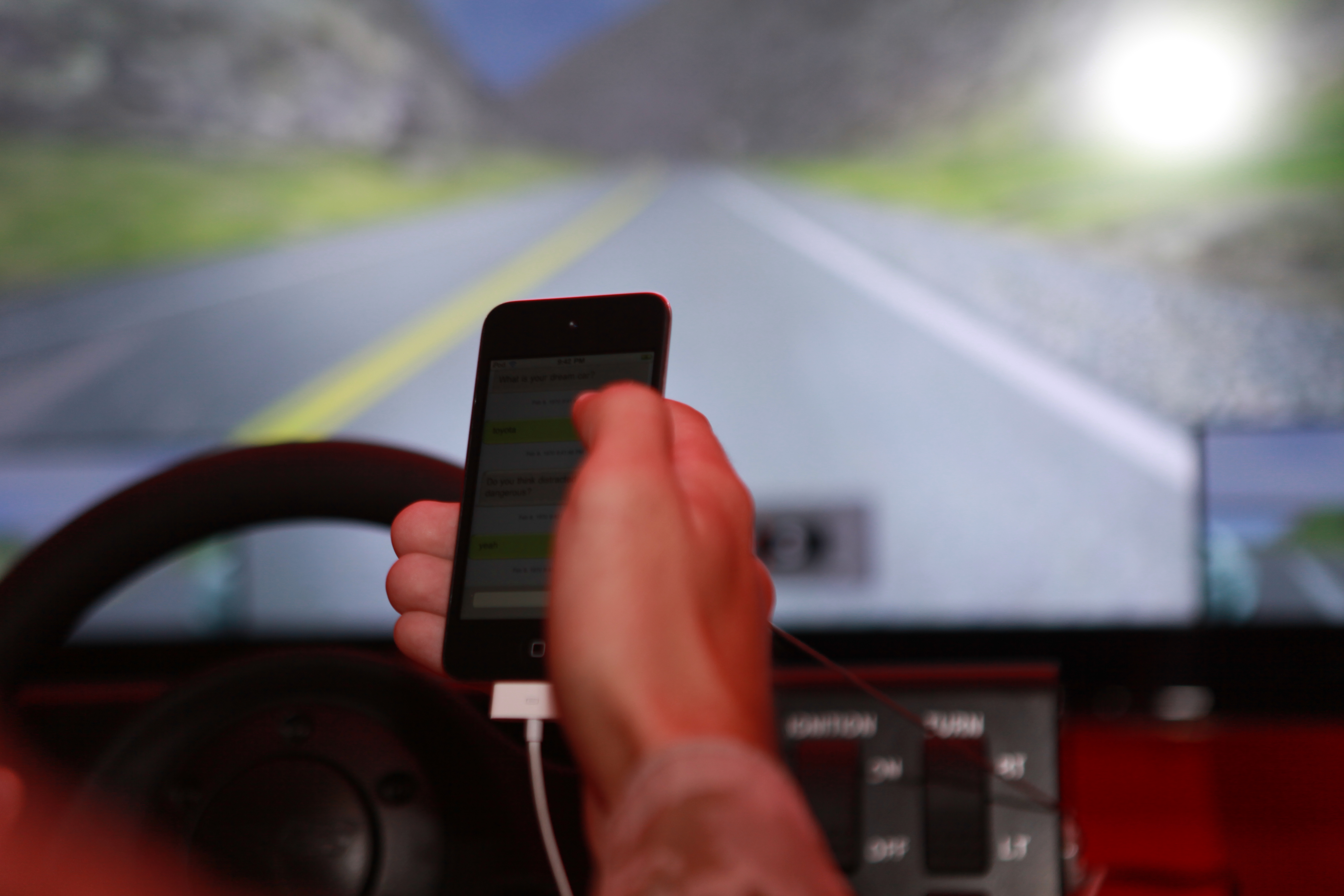
 A participant tests a text-while-driving simulator at the
Distracted Driving event aboard Marine Corps
Air Station Miramar, Calif., Nov. 4.
Ontario has a the provincial law on distracted driving. What would happen if we repealed it? The criminal code of Canada already has a section (249) prohibiting the operation of a powered vehicle or aircraft in a manner that endangers the public. Does anyone not think tooling down the road while taking a selfie, texting, or talking on a hand-held device endangers the public? Creating a special category of "distracted driving" allowed the legislature to create special (specially lenient) penalties. Dangerous driving carries a maximum sentence of five years in prison. Distracted driving carries a maximum sentence of a thousand dollar fine and three points on your license. The real distinction, however, kicks in if a distracted driver kills someone. Provincial laws do not increase the penalties for driving offences when a death or bodily harm results. If the province didn't have specific legislation on distracted driving, but rather a regulation requiring prosecutors to pursue charges of dangerous driving against distracted drivers, driving into someone and killing them while answering a text could mean up to a up to fourteen years in prison.

Section 252 of the criminal code of Canada prescribes penalties for leaving the scene of an accident. What if we replaced it by a law that made it a criminal offence to hit someone with a vehicle and injure or kill them? The law could allow drivers to present, as an affirmative defence, that they had operated according to the law and prudently given the conditions, and that the crash came about because of factors they could not control. A driver who left the scene of the crash would only escape criminal liability if they could escape detection indefinitely. Drivers who left the scene of a fatal crash would find it impossible to explain their behaviour, and the courts would convict and sentence them for the essential offence: killing someone with a motor vehicle.

Legal simplification only works if the courts will apply common sense when enforcing the law. It makes sense that when manually controlling an automobile that covers twenty meters every second, a person taking their eyes and concentration of the road for the thee seconds it takes to send a text endangers everyone within sixty meters, but how many dangerous driving charges did the police lay against texting drivers before the province passed the distracted driving law?

As long as we stay with the social convention that we will never require drivers to apply even the most rudimentary logic, that no act behind the wheel violates the law unless the law specifically prohibits it and a police officer witnesses it, we will always need more and more detailed laws. The penalties these laws prescribe will always fall between the need to deter and denounce truly dangerous behaviour, and the impulse to keep motoring available for everyone. We have to live with that situation, at least for now, but that does not mean we should accept it. In principle, fewer laws, backed by a social and legal consensus that we need not pay our road tolls in blood and that we ought not to condone behaviour that endangers other people, would serve us much better.